

Creatine Before or After Your Workout?
So, when is the best time to take creatine? The honest answer is that just taking it consistently is far more important than the exact time you take it. If you're looking for that extra 1% edge, some research suggests that taking creatine shortly after your workout might be slightly better for building muscle. But let's be clear: the real goal is to keep your muscles saturated with creatine by taking it daily.
Decoding Creatine Timing: Your Ultimate Guide

The pre- vs. post-workout creatine debate is a classic in the fitness world. Should you load up your muscles before you train, or should you help them recover and grow afterward? It really comes down to how creatine works. Its main job is to help your body quickly regenerate its main energy source, adenosine triphosphate (ATP), which is crucial during intense exercise. Getting a handle on what creatine does for your muscles is the first step to figuring out your timing.
The benefits are undeniable. A typical loading phase—taking four 5-gram doses a day for 5 days—can boost the total creatine in your muscles by around 50%. This translates to real-world results, with studies showing performance jumps of 5%–15% in explosive, high-intensity activities. These gains come from having more phosphocreatine available in your muscles, not from pinpoint-perfect timing.
Quick Guide to Creatine Timing
To make things simple, here’s a quick breakdown based on what you’re trying to achieve. Remember, consistency beats perfect timing any day of the week, but this can help you fine-tune your approach.
| Your Goal | Timing Recommendation |
|---|---|
| Maximize Muscle Growth & Strength | Slightly Favors Post-Workout. Take creatine with protein and carbs within an hour after your session. This can potentially improve nutrient absorption and kickstart muscle repair. |
| Improve Workout Performance | Theoretically Favors Pre-Workout. Taking it 30-60 minutes before you train could, in theory, make more phosphocreatine immediately available for better power output during your workout. |
| General Health & Consistency | Any Time of Day. The most critical part is daily intake. Find a time that works for you—morning, night, with a meal—and stick to it to keep your muscles topped off. |
At the end of the day, the difference between taking creatine before or after training is pretty small for the average person. Don't stress over it.
The best creatine strategy is the one you can follow every single day. Muscle saturation is what delivers creatine's proven benefits for strength and recovery—not perfect timing.
Let's dive deeper into the science behind pre- and post-workout timing. Understanding the subtle differences can help you build a supplement plan that fits your goals and, just as importantly, your daily routine.
The Argument for Post-Workout Creatine

While just taking creatine consistently is the most important thing, there's a compelling argument to be made for timing it after your workout. This strategy is based on sound physiology. After a tough training session, your body flips into a unique metabolic state where it’s practically begging for nutrients to kickstart the repair process.
Think of your muscles post-workout as sponges. They're depleted and ready to soak up anything you give them. Blood flow to the muscles you just worked is way up, and your cells are more sensitive to insulin. This creates a prime opportunity for your body to shuttle nutrients—like glucose, amino acids, and yes, creatine—directly into your muscle cells where they can get to work.
Capitalizing on Your Body's Recovery Mode
The post-workout window is all about two things: refueling spent energy stores and firing up muscle protein synthesis, which is the engine of muscle growth. By tossing creatine into the mix during this critical time, you're supplying a key recovery ingredient when your body is most receptive.
This timing syncs up perfectly with the classic post-workout protein shake. In fact, combining them can be a simple and highly effective strategy for your recovery and muscle-building goals. You can learn more about how to properly stack creatine and protein together for the best results.
The post-exercise state enhances the body's ability to shuttle nutrients into muscle cells. Timing your creatine intake to coincide with this period aims to maximize absorption and kickstart the recovery process more efficiently.
The idea behind post-workout creatine isn't just theory; it's rooted in the body's natural recovery mechanisms. Let's break down the key physiological factors at play.
Potential Mechanisms for Post-Workout Creatine Efficacy
| Physiological Factor | How It May Enhance Creatine Uptake |
|---|---|
| Increased Blood Flow | Exercise significantly boosts blood circulation to the working muscles. This increased flow acts like an express delivery system for nutrients, potentially getting creatine to muscle cells faster. |
| Heightened Insulin Sensitivity | Post-exercise, your muscles are more sensitive to insulin, a hormone that helps transport nutrients into cells. This heightened sensitivity may facilitate more efficient creatine uptake. |
| Glycogen Replenishment | Consuming creatine with carbohydrates post-workout can enhance muscle glycogen and creatine storage, as the insulin spike from carbs helps drive both into the muscle cells. |
| Muscle Cell Permeability | The mechanical stress of resistance training may temporarily increase the permeability of muscle cell membranes, making it easier for creatine to enter. |
These factors work together to create an environment where your muscles are exceptionally primed for nutrient absorption, which is the core of the post-workout creatine argument.
Some research backs this up. A well-known 2013 study, for example, showed that men who took 5 grams of creatine right after their workouts for four weeks gained more lean mass than the group taking it beforehand. It’s worth noting, however, that other studies haven't found such a clear-cut difference, suggesting the benefit might be small but still potentially meaningful for those looking to optimize every detail.
Ultimately, taking creatine post-workout is about stacking the deck in favor of recovery. While the timing itself is just one piece of the puzzle, combining it with other smart habits is key. For a more complete plan, check out these top post-workout recovery tips to round out your strategy.
The Argument for Pre-Workout Creatine
Taking creatine before you train seems like a no-brainer, right? The logic is simple: you’re front-loading your muscles with the fuel they need right before they have to perform. Think of it as topping off your tank right before a big race.
The whole point of creatine is to help your body quickly recycle adenosine triphosphate (ATP), the high-octane fuel for short, explosive movements. By taking a dose 30-60 minutes before your workout, you’re aiming to make sure your phosphocreatine stores are completely full the second you pick up the weights.
This timing could be what helps you grind out that last rep on a heavy squat or push through one more set of bench presses. Those extra reps are exactly what stimulate muscle growth over time, so the potential benefit is clear.
The Psychological Edge of Pre-Workout Rituals
Don't underestimate the mental game. For many people, mixing up their pre-workout drink—with creatine in it—is a powerful ritual. It flips a switch in your brain, signaling that it’s time to get serious.
This habit can build a real sense of confidence before you even step on the gym floor. Knowing you’ve given your body everything it needs to perform can sharpen your focus and help you attack your workout with more intensity from the get-go.
While a single pre-workout dose might not dramatically boost performance if your muscles aren't already saturated, its power as part of a consistent pre-training ritual can provide a serious psychological advantage.
It's important to keep things in perspective here. The science doesn’t overwhelmingly prove that pre-workout timing is far superior to post-workout. In fact, some studies lean the other way.
What matters most for creatine to work its magic is consistent, daily intake to keep your muscles fully saturated. Still, for anyone who thrives on routine and wants that potential in-the-moment boost, taking creatine before training is a perfectly solid strategy.
A Head-to-Head Look at the Science
When you start digging into the research on creatine timing, you’ll find the science isn't as black and white as you might expect. Several studies have tackled the pre- versus post-workout question, but a clear winner hasn't emerged. There’s no slam-dunk consensus in the scientific community, which tells us the difference is likely small.
Some of the early research seemed to lean towards a post-workout advantage. These studies showed slightly better gains in muscle mass and strength for people who took their creatine after hitting the weights. But then, other studies came along and found no real difference between the two. This back-and-forth suggests that while a tiny edge for post-workout timing might exist, it’s far from a game-changer.
The biggest takeaway from all this research is simple: consistent, daily creatine intake is what truly drives results. The whole point is to keep your muscles saturated with phosphocreatine. You get there by taking it every day, not by nailing the timing down to the minute.
So, What’s the Verdict?
What does all this mean for you? It means you can relax. The small potential benefit of post-workout timing might be something an elite athlete or competitive bodybuilder wants to chase, but for most of us, the best time is whatever time you’ll actually remember to take it.
We get so caught up in the pre- vs. post-workout debate that we often miss the main point: muscle saturation. The real magic of creatine happens when you keep your levels topped off over time. That’s a result of daily consistency, not perfect timing.
This practical mindset ensures you reap the powerful, proven benefits of creatine—like boosting your strength and speeding up recovery—without getting stressed about a minor detail that barely moves the needle.
That said, for certain people, timing might matter a bit more. Some comprehensive reviews hint that taking creatine right after a workout could lead to better lean mass and strength gains in older adults. The thinking is that resistance training increases blood flow, which might help the muscles soak up the creatine more effectively. You can dive deeper into the full findings on creatine timing for different populations if you're curious.
At the end of the day, while post-workout might have a slight edge in some cases, the advantage is modest. The real victory is just taking it consistently.
How to Build Your Perfect Creatine Strategy
Alright, let's move from the science to the real world. Crafting your creatine plan isn't about pinpointing the exact perfect minute to take it. It’s about building a solid, unbreakable habit. The whole "creatine before or after a workout" debate often misses the most important piece of the puzzle: consistency.
If you're a competitive athlete or a serious bodybuilder, every tiny advantage matters. In that case, timing your creatine post-workout alongside some carbs and protein could give you a slight edge in recovery and absorption. You’re essentially piggybacking on your body's heightened insulin sensitivity after a tough session, which can help shuttle more creatine straight into your muscles.
But for the rest of us—the busy professionals trying to balance work, family, and fitness—the best time is simply the time you won't forget. Whether that's stirred into your morning coffee or mixed in your evening protein shake, daily adherence is what keeps your muscles saturated and ready to perform.
This decision tree breaks down which path makes the most sense for you.
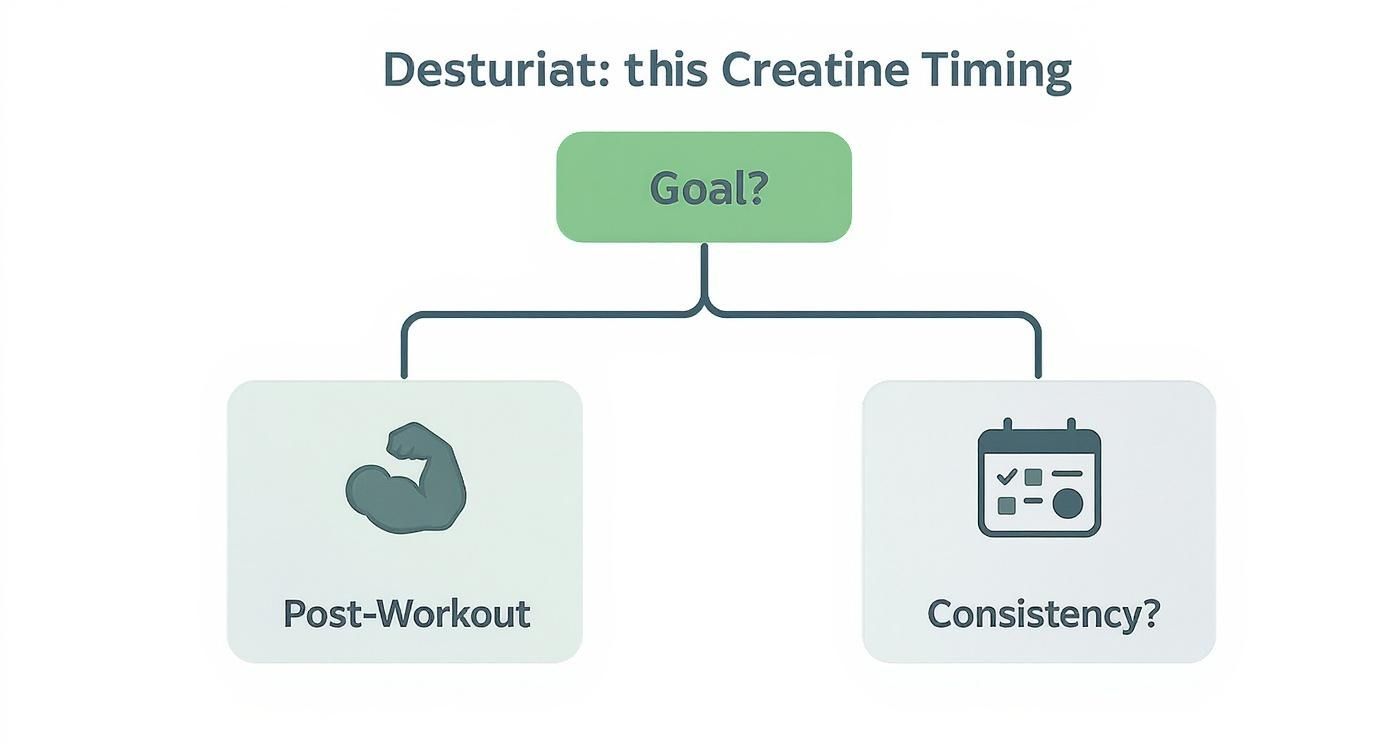
As you can see, the choice really comes down to your primary goal: are you chasing every last percentage point of gain, or are you focused on building an effortless, consistent routine?
Finding Your Timing Sweet Spot
Let your daily routine be your guide. Always slam a protein shake after hitting the gym? Perfect, toss your creatine in there. Start every single morning with a big glass of water? That's your new creatine moment.
The optimal creatine timing is the one that seamlessly integrates into your daily life, transforming supplementation from a chore into an automatic habit.
Once you've nailed down when you'll take it, the next question is how much. For a complete rundown on loading and maintenance phases, check out our comprehensive creatine dosage guide. At the end of the day, the most successful strategy is always the one built on simplicity and routine.
Your Top Creatine Timing Questions, Answered
Once you've decided on a pre- or post-workout strategy, the day-to-day questions start popping up. Nailing down these small details is what separates a confusing routine from one that feels effortless and effective. Let's tackle some of the most common sticking points.
First up is the classic creatine loading phase. This is where you take a high dose, typically 20 grams a day for a week, to fast-track muscle saturation. But is it mandatory? Absolutely not. You can get to the exact same place by just taking a consistent 3-5 grams daily—it'll just take about three or four weeks to fully top off your stores.
Do I Need to Take Creatine on Rest Days?
Yes, and this one is crucial. The whole point of taking creatine is to keep your muscle stores completely saturated, not just to get a boost for a single workout. Consistency is king.
Skipping your dose on off-days allows those levels to drop, which really defeats the purpose of supplementing in the first place. Think of it less as a "pre-workout" and more as a daily habit that keeps your muscles primed and ready for whenever you decide to train.
What Should I Mix Creatine With?
Creatine monohydrate plays well with almost any liquid, so you have options. Water is perfectly fine, but some research suggests you might get a slight edge by mixing it with carbohydrates or a combination of carbs and protein.
Why? This combination can trigger a small insulin response, and insulin is like a transport system that helps push nutrients like creatine into your muscle cells a bit more effectively. It's one of the big reasons why tossing it into a post-workout shake with protein and carbs is such a popular and smart move.
The perfect mixer is less important than perfect consistency. Whether it's plain water, juice, or your daily protein shake, find what's easiest for you and make it a non-negotiable part of your routine.
You could blend it into a fruit smoothie or just shake it up with your recovery drink. The goal is to make it so simple that you never miss a day. No matter if you land on taking creatine before or after your workout, showing up every day is what will ultimately deliver results.
Ready to make creatine supplementation simple, tasty, and effective? Smash.com offers premium creatine gummies that deliver your full 5-gram dose without the mess of powders. Visit Smash.com to smash your fitness goals.


