

how much water should i drink with creatine: quick guide
So, you're taking creatine and wondering how much water you really need to drink. It's one of the most common questions out there, and the answer is refreshingly simple.
As a rule of thumb, a good place to start is by adding an extra 12-16 ounces (about 0.5 liters) of water to whatever you're already drinking for every 3-5 gram dose of creatine. But honestly, the real key is to focus on consistent, solid hydration throughout the day, not obsessing over a precise number.
Your Simple Answer to Creatine Water Intake

Let's cut right to it. You don't need to suddenly start chugging a gallon of water the moment you add creatine to your routine. The goal is much more practical: ensure you're consistently and adequately hydrated for your body and your activity level. Think of it as meeting your personal needs first, then making a small tweak for the supplement.
It might surprise you, but despite how long creatine has been around, there isn't a single, universally agreed-upon guideline for extra water intake. Most major safety reviews have found that standard doses of 3–5 grams per day are perfectly safe when people just stick to normal hydration habits—which for most adults is around 2–3 liters daily. You can discover more insights about creatine safety studies that back up this sensible approach.
Establish Your Baseline First
Before you even think about the creatine, you need a solid hydration foundation. Your personal baseline is influenced by everything from your body weight and local climate to how hard you're training. A 200-pound athlete working out in the summer heat is obviously going to need more water than a 150-pound person with a desk job.
The best way to approach this is to see the extra water for creatine as a small "top-up" to your existing goal, not a massive overhaul of your daily routine.
To get started, let's figure out what your body needs for general health and performance, even without creatine. The table below gives you a solid starting point based on weight and activity level.
Baseline Daily Water Intake Recommendations
This table provides a starting point for daily water intake based on body weight and general activity level, before considering creatine.
| Body Weight (lbs/kg) | Sedentary (liters/ounces) | Moderately Active (liters/ounces) | Very Active (liters/ounces) |
|---|---|---|---|
| 120 lbs / 54 kg | 1.8 L / 60 oz | 2.4 L / 80 oz | 3.0 L / 100 oz |
| 150 lbs / 68 kg | 2.2 L / 75 oz | 3.0 L / 100 oz | 3.7 L / 125 oz |
| 180 lbs / 82 kg | 2.7 L / 90 oz | 3.6 L / 120 oz | 4.5 L / 150 oz |
| 210 lbs / 95 kg | 3.1 L / 105 oz | 4.2 L / 140 oz | 5.2 L / 175 oz |
Once you have a handle on this baseline number, tacking on that extra 12-16 ounces for your creatine dose becomes a simple, manageable adjustment instead of a guessing game.
Why Staying Hydrated is Non-Negotiable With Creatine
So, what’s the big deal with water and creatine? It all comes down to how creatine works inside your body, specifically within your muscle tissue. Think of creatine as a water magnet for your muscles.
When you take creatine, it heads straight to your muscles and pulls water into the cells along with it. This is a process called cell volumization, and it’s a huge part of what makes creatine so effective for performance. This cellular swelling is actually a signal for your muscles to grow bigger and stronger.
A common myth is that this process dehydrates you. Creatine doesn't magically make water disappear; it just shifts it into your muscle cells where it can do the most good. This is precisely why keeping your overall hydration on point is so critical.
The Science Behind Cellular Hydration
The way creatine increases total body water isn't just a gym bro theory—it's backed by solid science. For example, controlled studies have consistently shown that people taking creatine monohydrate experience a significant uptick in their total body water within just a few weeks. The best part? This fluid is held inside the muscle, not under the skin causing a bloated look. You can dive into the full research on creatine's hydration effects and see the data for yourself.
This intracellular water retention is a game-changer for a few reasons:
- Better Nutrient Delivery: Hydrated cells are far more efficient at moving nutrients around for energy and muscle repair.
- Boosted Protein Synthesis: That "swollen" cell state actually triggers an anabolic signal, kicking muscle protein synthesis into a higher gear.
- Enhanced Performance: Proper hydration is key for regulating your body temperature and ensuring your muscles contract powerfully during tough workouts.
By drinking enough water, you’re not just avoiding dehydration. You're actively supercharging the very process that makes creatine work. Without enough fluid, creatine simply can't do its job of volumizing your muscle cells.
This also underscores the need to support the rest of your body's systems. When more water is being shuttled to your muscles, you have to make sure there's plenty left for everything else, like your vital organs. Great hydration helps your kidneys effectively process creatine's byproducts. There are a lot of myths out there, so it's worth taking a moment to find out if creatine can damage your kidneys. Staying well-hydrated is really the simplest way to keep everything running smoothly.
How to Figure Out Your Personal Hydration Target
Forget the generic "drink eight glasses a day" advice. When you're supplementing with creatine, you need a smarter, more personalized approach. Think of it less like a rigid rule and more like building a flexible hydration plan that adapts to you. We'll start with a solid baseline and then layer in the key variables: your creatine dose and your activity level.
A really practical starting point is to drink half your body weight (in pounds) in ounces of water. So, if you weigh 180 pounds, your daily baseline is 90 ounces (about 2.7 liters). This is your foundation for good health, even before we factor in creatine.
This visual gives you a great look at what creatine is actually doing inside your body—pulling water directly into your muscle cells.
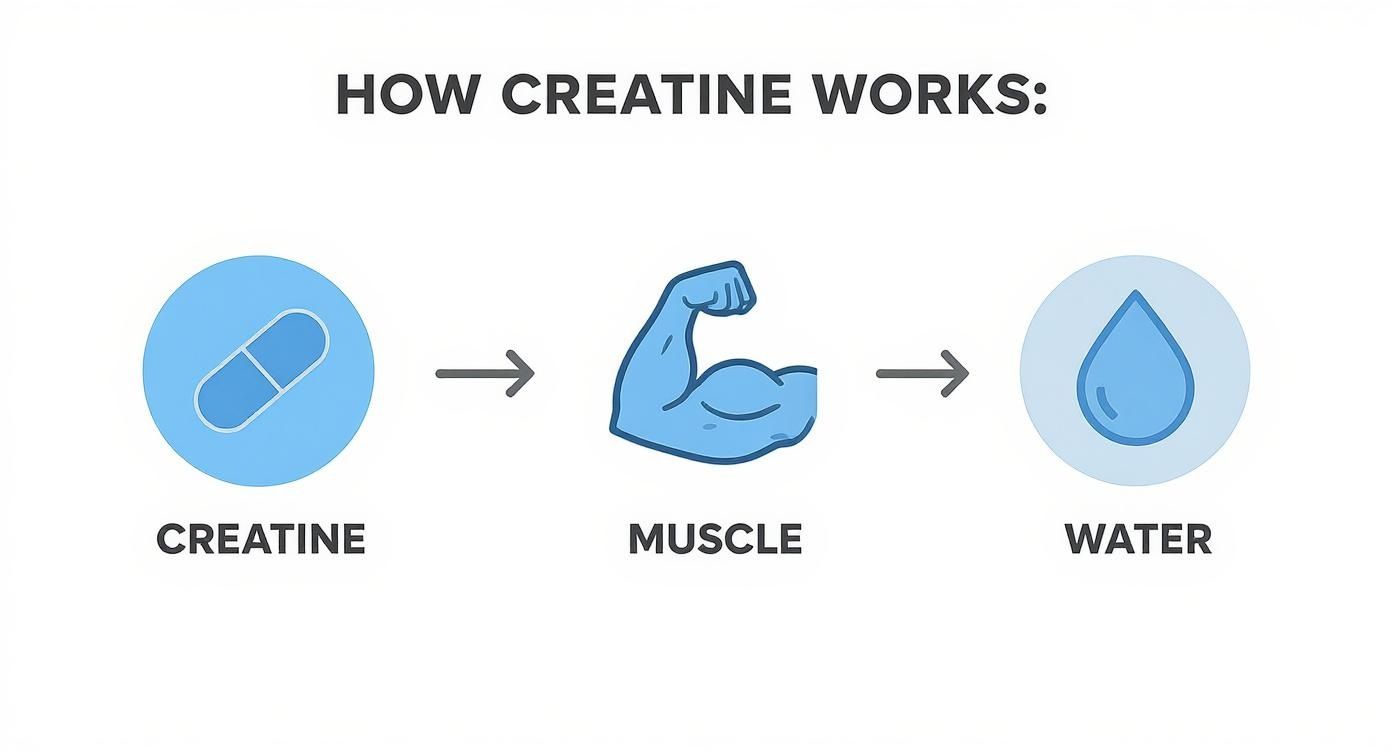
As you can see, creatine’s whole job is to boost cellular hydration. That's precisely why having enough water in your system is non-negotiable for it to work its magic.
Fine-Tuning Your Daily Goal
Once you have that baseline number, it's time to adjust it for creatine and training. This simple formula lets you dial in your intake every single day.
- For Your Creatine Dose: For every 3-5 gram serving of creatine, tack on an extra 12-16 ounces (0.4-0.5 liters) of water. This is crucial for making sure the creatine gets absorbed properly and can do its job of volumizing your muscle cells.
- For Your Workouts: For every hour of intense exercise, plan on drinking another 16-20 ounces (0.5-0.6 liters). If you’re sweating buckets or training in the heat, you'll probably need to bump that up even more.
Let's See it in Action:
Let's go back to our 180-pound person. Their baseline is 90 oz. They take 5g of creatine (+16 oz) and crush a 60-minute workout (+20 oz). Their new daily hydration target is 126 ounces (about 3.7 liters).
Suddenly, the question of how much water to drink with creatine isn't a guessing game anymore. It's a simple, personalized calculation.
It's also worth noting that more creatine doesn't always mean you just need more and more water. Interestingly, some research on hydration strategies suggests that people taking very high doses of creatine can sometimes have lower total body water than those on a moderate dose. This just drives home how important a personalized, adjustable plan is. Using this formula keeps your fluid intake matched to your real-world needs, so you’re not left under-hydrated or constantly running to the bathroom.
Practical Ways to Stay Consistently Hydrated

Knowing your daily water goal is the easy part. The real challenge—and where the results come from—is actually hitting that number day in and day out. It's all too common to start the morning strong, only to have hydration fall by the wayside as meetings, errands, and life get in the way.
The trick is to build simple habits that make drinking water almost automatic.
Instead of just "trying to remember," make it impossible to forget. A large, reusable water bottle with time markers is a game-changer. That visual cue on your desk, showing you where you should be by 9 AM or 1 PM, turns hydration into a simple, all-day challenge you can actually win.
Another great tactic is "habit stacking"—linking your water intake to things you already do automatically. Try making it a rule to drink a full glass of water right after brushing your teeth, before every meal, and another when you wrap up your workday. Before you know it, you've added several glasses to your daily total without even thinking about it.
Build Your Hydration Toolkit
Chugging plain water all day isn't the only way to stay hydrated, especially when you're on creatine. Getting a little creative can make a big difference and keep things interesting.
- Eat Your Water: You'd be surprised how much fluid you can get from food. Foods like cucumbers, celery, watermelon, and strawberries are packed with water and can give your daily intake a nice boost.
- Use Your Tech: Sometimes a simple nudge is all you need. Using one of the many habit tracking apps for monitoring water intake can send you reminders and keep you accountable.
- Time It Right: Always take your creatine with a full glass of water. This simple step helps with absorption and immediately gets you ahead on your daily hydration. For more tips, check out our guide on what to take creatine with.
A quick word of advice: Consistency beats perfection every time. If you fall a little short one day, don't sweat it. Getting close to your goal is a win and is infinitely better than giving up completely.
Finally, don't forget about electrolytes, particularly after a tough, sweaty workout. Intense training drains not just water but also crucial minerals like sodium and potassium. Grabbing a sports drink or an electrolyte mix post-workout can replenish these stores much more effectively than plain water, helping your muscles recover and stay properly hydrated for the next session.
Learning to Read Your Body’s Hydration Signals
Instead of just chugging water and hoping for the best, you can get a lot more precise by learning to read the signals your body sends you every single day. This is the difference between following generic advice and making smart, real-time adjustments that will help you get the most out of your creatine supplementation.
The easiest and most reliable tool you have is right there in the bathroom: the urine color test. It’s immediate, costs nothing, and gives you a surprisingly accurate snapshot of your hydration status.
-
What you want to see: A pale, straw-like yellow. This is the sweet spot. It means you’re well-hydrated enough for your body and your creatine to work efficiently.
-
What you don't want to see: Dark yellow or amber. This is a clear red flag that you're dehydrated. Your body is holding onto every drop of water it can, and you need to drink up.
-
A sign of too much: If it's consistently crystal clear, you might actually be overdoing it. This can flush out essential electrolytes, so it's a sign to ease up a bit.
Beyond the Basics of Thirst and Urine
Waiting until you feel thirsty is a mistake. By the time that sensation hits, you're already behind and playing catch-up from a state of mild dehydration. To get a more complete picture, you can add a couple of other simple checks to your routine.
One is the skin turgor test. It sounds technical, but it’s incredibly simple. Just gently pinch the skin on the back of your hand for a couple of seconds. If it snaps back instantly, you're in good shape. If it slowly settles back down, it’s a good sign you could use some more fluids.
For anyone who trains hard, weighing yourself before and after a workout is an absolute game-changer. For every pound you drop during a session, you’ve lost about 16 ounces of fluid. This is your personal sweat rate, and knowing it helps you replenish exactly what you lost.
Common Questions About Creatine and Water
Even with the best plan, you're bound to have some questions. Let's walk through some of the most common things people ask when they're dialing in their water intake with creatine. This should give you the confidence you need to get it right.
A big concern for many is the risk of side effects. What happens if you don't drink enough water? You might run into some minor but annoying issues like stomach cramps or bloating. This happens because creatine's job is to pull water into your muscles, and when there isn't enough to go around, your digestive system can feel the pinch.
In fact, poor hydration is often a key reason some people find that creatine might give them headaches, as the body’s fluid balance gets thrown off.
What About a Loading Phase?
A lot of people ask if they need to drink even more water during a creatine loading phase—that initial week of taking 20-25 grams a day. The short answer is yes, absolutely.
During that loading period, your muscles are like sponges, soaking up as much creatine as they can. This process pulls in a significant amount of water along with it. A good rule of thumb is to add an extra 32-48 ounces (1-1.5 liters) of water to your daily total during the load. This helps support the process and keeps you feeling your best.
Let's bust a common myth: the idea that you can't have coffee or tea. The old theory that caffeine negates creatine's effects has been soundly debunked by research. Your morning coffee is perfectly fine to enjoy in moderation, and it even counts toward your daily fluid intake.
Tired of messy powders and shaking up drinks? Smash.com makes it easy with delicious, high-quality creatine gummies that give you a perfect 5g dose anytime, anywhere. Check them out at https://smash.com and smash your fitness goals.


