

Creatine Monohydrate vs HCl The Ultimate Showdown
If you're looking for the short answer, creatine monohydrate is the clear winner for most people. It's the most studied, most proven, and most cost-effective form of creatine on the market. Think of it as the tried-and-true gold standard for building muscle and strength.
Creatine HCl, on the other hand, is a newer player that claims to offer better solubility and absorption, making it a potential alternative for anyone who experiences digestive issues with monohydrate.
Comparing Monohydrate vs. HCl: The Core Differences
When you're weighing creatine monohydrate against HCl, you're not just comparing two powders; you're looking at two different approaches to supplementation. Monohydrate is the original formula with decades of research behind it. HCl was engineered to address some of monohydrate’s minor drawbacks, like mixability and bloating.
The biggest advantage for monohydrate is its massive body of research. We're talking over 1,000 studies confirming its ability to boost strength, power output, and muscle growth. It’s a simple compound—a creatine molecule bonded to a water molecule—that has a proven muscle absorption rate of over 99%.
Creatine HCl tweaks this formula by attaching a hydrochloride group to the creatine molecule. This simple change dramatically increases its solubility in water. The main selling point here is that better solubility could lead to better absorption, meaning you can get away with a smaller dose and potentially sidestep the stomach discomfort some people report with monohydrate.
To really see how these two stack up, let's break down the key factors in a quick comparison table.
At-a-Glance: Creatine Monohydrate vs. Creatine HCl
This table gives you a quick snapshot of the most important distinctions between the two forms.
| Feature | Creatine Monohydrate | Creatine HCl |
|---|---|---|
| Research Evidence | Extensively studied (1,000+ studies) | Limited human performance studies |
| Standard Daily Dose | 3-5 grams | 1-2 grams |
| Solubility | Lower; can feel gritty if not mixed well | High; dissolves almost instantly in water |
| Cost Per Serving | Low (~$0.10 - $0.30) | High (~$0.50 - $1.00) |
| Primary Use Case | The proven choice for all athletes | A niche option for those with GI sensitivity |
As you can see, monohydrate leads in scientific backing and value, while HCl's main advantages are its lower required dose and superior mixability.
This infographic really drives home the three most important points of comparison: the research, the dose, and the cost.
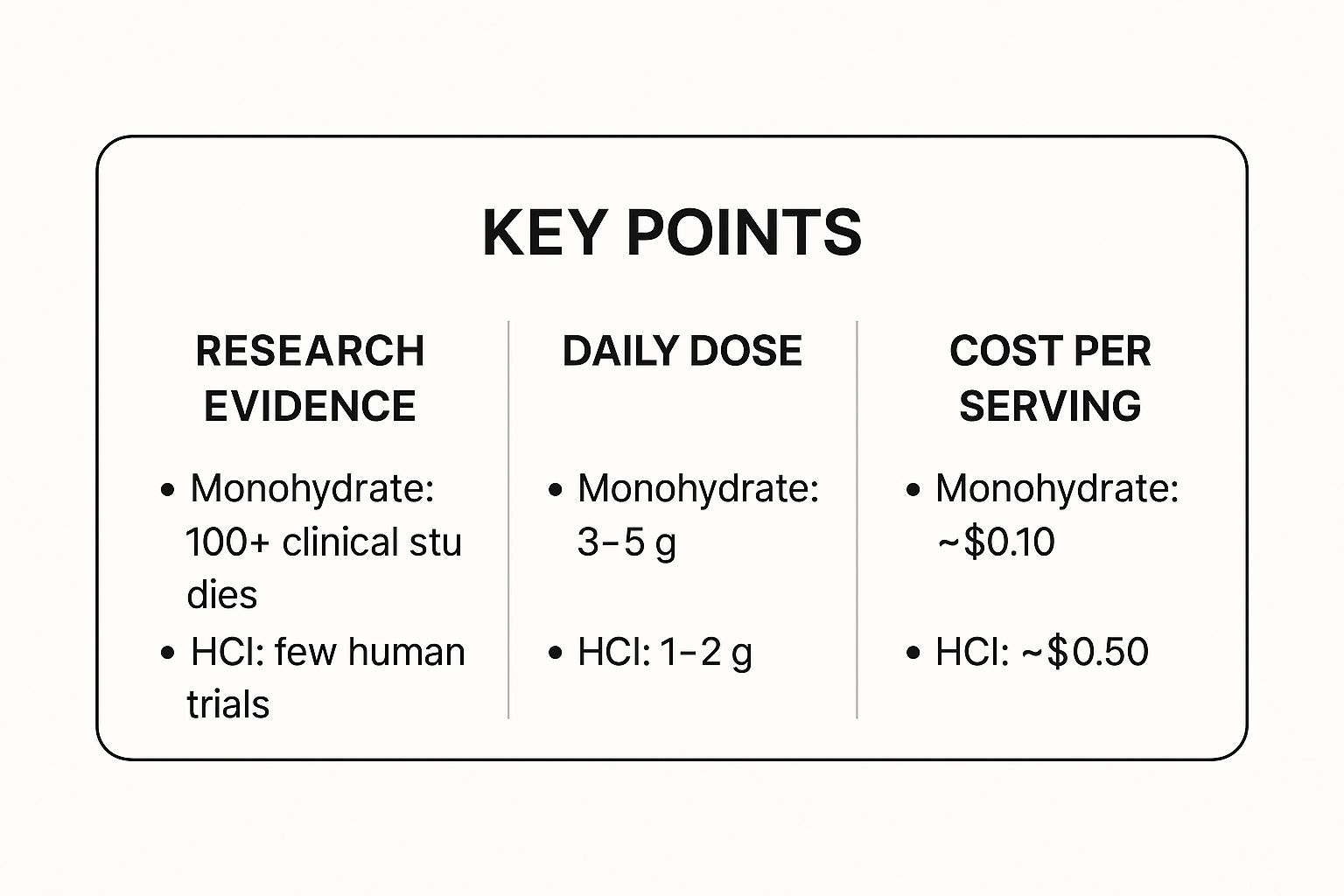
The data makes it pretty clear. Monohydrate is dominant when it comes to scientific proof and affordability. HCl’s only real claim to fame is its lower dosage requirement, which stems from its higher solubility.
Understanding the Science Behind Each Form
To really get to the bottom of the monohydrate vs hcl debate, we need to look at what sets them apart at a molecular level. Don't worry, you don't need a chemistry degree for this part.
Creatine monohydrate is the original, the one that started it all. It’s simply a creatine molecule bound to a single water molecule—hence, "mono-hydrate." This is the exact form that has been put through the wringer in hundreds of clinical studies, proving its effectiveness for boosting strength, power, and muscle mass.
Then you have creatine HCl, the newer kid on the block. Scientists created this version by attaching a hydrochloride group to the creatine molecule. This wasn't just for kicks; it was a deliberate change designed to solve a very specific problem: making it dissolve better in water.
Why Molecular Structure Matters
So, what does adding a hydrochloride group actually do? It makes creatine HCl more acidic, which in turn makes it much more soluble in water compared to monohydrate. Imagine trying to stir coarse sea salt into a glass of cold water versus fine table salt—one mixes in almost instantly, while the other takes some work. That’s the core idea here.
This enhanced solubility is the entire marketing angle for creatine HCl. The theory goes that if it dissolves more easily in your shaker cup, it must absorb more efficiently in your gut. This, in turn, would mean you could get away with a smaller dose and sidestep common side effects like bloating.
Key Takeaway: The fundamental difference is the molecule attached to the creatine. Monohydrate is bonded to water, making it the classic, heavily-researched form. HCl is bonded to a hydrochloride group, making it significantly more water-soluble.
This isn't a new concept. Attaching an HCl group to improve a compound's properties is a common practice. For example, the global market for L-cysteine HCl monohydrate, an ingredient prized for its antioxidant qualities in foods and supplements, was valued at USD 450 million in 2024. As detailed in market analysis from Verified Market Reports, this technique is well-established for creating specialized, high-value compounds.
From Structure to Function
While the chemical differences are straightforward, the million-dollar question is whether any of this actually translates to better results in the gym. This is where things get interesting.
Gram for gram, creatine monohydrate is about 88% pure creatine by weight; the other 12% is just the water molecule. Creatine HCl, on the other hand, is closer to 78% creatine by weight because the hydrochloride group is heavier.
This means you’re actually getting more pure creatine in every scoop of monohydrate. The whole debate hinges on whether HCl's supposed superior absorption is powerful enough to make up for the fact that you're starting with less creatine per gram. That's the core issue we'll dig into next.
Unpacking the Absorption and Solubility Debate

The whole debate between creatine monohydrate vs HCl really boils down to one thing: how well it dissolves and how well your body absorbs it. Creatine HCl’s main selling point is its superior solubility. It mixes into water almost instantly, which is a fact no one can argue. If you've ever choked down the last gritty sip from your shaker cup, you know exactly what I'm talking about—that’s monohydrate for you.
But here’s where the marketing gets a bit clever. There’s a huge difference between how easily a powder mixes in water (mixability) and how much of it your body actually puts to use (bioavailability). A lot of the hype around creatine HCl banks on people confusing the two.
Does Better Solubility Actually Mean Better Absorption?
It’s easy to assume that if something dissolves better, your body must absorb it better. It sounds logical, but when we look at the science of creatine, that assumption falls apart. The truth is, your body is already incredibly good at absorbing good old creatine monohydrate.
Study after study confirms that the bioavailability of creatine monohydrate is over 99% when you take it as directed. Your digestive system is more than capable of taking that monohydrate, breaking it down, and getting it into your bloodstream to be shuttled to your muscles. Almost none of it goes to waste.
The real issue isn't whether your body can absorb creatine monohydrate—it already does this with near-perfect efficiency. This means a more soluble form like HCl is essentially trying to fix a problem that doesn't exist physiologically.
Since monohydrate absorption is already maxed out, there’s simply no room for a different form to offer a meaningful advantage in how much creatine your body actually gets. That little bit of sandy texture at the bottom of your cup isn't a sign that it’s failing to be absorbed by your gut. Trying to "improve" on 99% bioavailability is like trying to make water wetter—you're already at peak performance. For a closer look at how processing can impact that gritty feeling, it's worth understanding the difference between monohydrate and micronized creatine.
What's the Point of the Hydrochloride Then?
So, what does the hydrochloride (HCl) part even do? On a larger scale, HCl is a major industrial chemical, with global demand expected to jump from USD 2.2 billion in 2024 to USD 3.0 billion by 2029, driven by its use in steel manufacturing and water treatment. In the world of supplements, its only real job is to make the creatine molecule dissolve more easily in water.
As soon as creatine HCl hits your stomach, the acidic environment—which is literally made of hydrochloric acid—breaks the bond between the creatine and the hydrochloride. You’re then left with the same free creatine molecule you'd get from monohydrate, ready for absorption. The HCl simply joins the acid already in your stomach. There's no secret, enhanced pathway that gives it an advantage once it's inside you, which is why there's a lack of human studies showing it leads to better real-world results.
Putting Performance and Research Head-to-Head
When you're picking a supplement, the only thing that really matters is, "Does it actually work?" In the monohydrate vs hcl debate, the answer lies in decades of hard science, and the evidence is pretty one-sided.
Creatine monohydrate isn't just another product on the shelf; it's arguably the most researched sports supplement in history. We're talking about hundreds of peer-reviewed studies all pointing to the same conclusion: it significantly boosts strength, increases power, and helps you build lean muscle. This mountain of data makes it the undeniable gold standard for anyone who makes decisions based on proven results.
The Research Gap for Creatine HCl
On the other hand, the research file on creatine HCl is surprisingly thin, especially when it comes to human performance. Sure, it’s still creatine, so it will provide benefits. But the big marketing pitch—that it's a superior version of monohydrate—just doesn't have the science to back it up. Most of the studies out there focus on how well it dissolves in water, not whether it delivers better results in the weight room.
Even though some newer studies suggest both forms work similarly at the same doses, there's no solid evidence showing HCl outshines the original. This leaves a massive gap between the marketing hype and what's been scientifically proven. If you want a deep dive into how creatine actually works to build muscle, checking out the fundamentals of creatine for muscle growth is a solid place to start.
Landmark studies have shown time and again that creatine monohydrate plus resistance training can boost your max strength by 8% and the number of reps you can bang out by 14% compared to training alone. That’s a level of documented performance that newer forms like HCl just haven't matched.
Market Trends vs. Scientific Fact
Despite the clear research gap, creatine HCl has managed to find its audience. Creatine monohydrate still dominates the global market, but HCl supplements are picking up steam, with a projected market size of USD 670 million in 2024. This growth is almost entirely driven by claims of better solubility and fewer side effects, even as the scientific community is still waiting for definitive performance data. To see just how fast this market is expanding, you can dig into this creatine supplements market report from Dataintelo.com.
At the end of the day, your choice should come down to the evidence. While HCl is a perfectly fine form of creatine, its supposed performance benefits are, for now, mostly theoretical and based on anecdotes. For anyone serious about their training who values scientifically validated results, creatine monohydrate's long and proven track record is simply unmatched. The research is crystal clear: it’s a reliable and powerful tool for getting stronger, proven over and over in countless human trials.
What About Dosage, Cost, and Side Effects?
Beyond the lab, the real-world factors of dosage, cost, and side effects are often what sway the decision in the monohydrate vs. HCl debate. These practical points hit you where it counts: your daily routine, your wallet, and how your body actually feels.
Creatine monohydrate’s protocol is tried and true: a standard dose of 3-5 grams a day keeps your muscles saturated. Creatine HCl, however, is marketed with a much smaller "micro-dose," usually around 1-2 grams daily. The logic is that its superior solubility means you need less, but as we've covered, monohydrate's absorption is already fantastic. The "less is more" claim for HCl is still on shaky ground without solid human studies to back it up.
If you need help figuring out the right amount for your goals, our detailed creatine dosage guide breaks it all down.
Navigating Side Effects and Stomach Upset
One of the loudest arguments for choosing HCl is that it might sidestep the bloating and stomach issues some people get from monohydrate. While these side effects aren't widespread, they can pop up, especially if you're doing a heavy loading phase or not mixing the powder with enough water.
Since HCl dissolves so well and the dose is smaller, it's often pitched as the gentler choice for sensitive stomachs. This is a fair point for the small group of people who consistently feel uncomfortable with monohydrate.
For most people, creatine monohydrate causes no issues. The idea that HCl is a magic bullet for side effects is more marketing than reality. Staying hydrated and sticking to the right dose usually solves any problems with monohydrate.
The Bottom Line: Your Wallet
Here’s where the difference really stands out: the price tag. Creatine monohydrate is one of the cheapest, most effective supplements on the market. We're talking pennies per gram, making it a no-brainer for long-term use.
Creatine HCl, however, comes at a premium. Its more involved manufacturing process and marketing as a "designer" creatine mean you'll pay a lot more for each serving. So, you have to ask yourself if slightly better mixability and a potential reduction in bloating are worth the extra cash.
This table puts these practical differences side-by-side.
Practical Usage: Monohydrate vs. HCl
| Factor | Creatine Monohydrate | Creatine HCl |
|---|---|---|
| Daily Dose | 3-5 grams | 1-2 grams |
| Side Effects | Potential for bloating/GI issues in sensitive users, often due to poor mixing or high doses. | Marketed as having fewer GI side effects due to higher solubility and smaller dose. |
| Cost Per Serving | Very low (~$0.10 - $0.30) | High (~$0.50 - $1.00+) |
When you lay it all out, the cost-effectiveness of monohydrate is hard to ignore, especially when its performance is backed by decades of research.
How to Choose the Right Creatine for You
https://www.youtube.com/embed/fZ0lUIF2q4c
After digging into the science, performance results, and practical side of things, the monohydrate vs. HCl debate starts to clear up. The "best" creatine isn't a single product—it's about what lines up with your specific goals, your budget, and how your own body responds.
For the vast majority of people, creatine monohydrate is the undeniable winner. Its effectiveness is backed by decades of solid research, making it the most dependable and affordable option you can find.
Who Should Choose Creatine Monohydrate?
This is the form I recommend for just about everyone. It’s the perfect fit if you fall into one of these camps:
- Beginners: If you're new to creatine, start with the one that has the most extensive safety and performance data behind it. No guesswork needed.
- Seasoned Athletes: Why mess with a good thing? Stick with the proven gold standard that delivers consistent, predictable results.
- Budget-Conscious Individuals: You get all the proven benefits at a fraction of the cost of the newer, fancier alternatives. Monohydrate delivers maximum bang for your buck.
Put simply, if you want a supplement that's guaranteed to work and won't drain your wallet, monohydrate is the way to go.
When to Consider Creatine HCl
Creatine HCl really only makes sense in a very specific situation. It’s not a better creatine; it’s more of a problem-solver for a small group of people.
Creatine HCl is best seen as a specialized alternative. It's for people who've already tried creatine monohydrate and consistently run into digestive issues like bloating or stomach cramps. The higher cost is basically what you pay for potentially better tolerance.
This form is a logical choice only if you're sensitive to monohydrate and are willing to pay a premium for comfort. For everyone else, the slight advantages just don't justify the significant price jump.
At the end of the day, consistency is what truly matters, so the best choice is the form you'll actually take every single day.
Got Questions? We've Got Answers
Even after breaking it all down, you might still have a few questions floating around about creatine monohydrate and HCl. Let's tackle some of the most common ones I hear from people trying to make the right choice.
Do I Really Need to Do a Loading Phase with Creatine HCl?
You don't have to do a loading phase with either form, but let's clear up the "why." With monohydrate, loading is just a shortcut—a way to saturate your muscles with creatine in about 5-7 days instead of the 3-4 weeks it would take with a smaller, daily dose. It gets you to the finish line faster, that's all.
Manufacturers of creatine HCl love to advertise that "no loading is needed," mainly because of its supposed superior absorption. The reality is, most people using HCl just stick to the much smaller recommended dose of 1-2 grams from day one. So, you're not loading simply because the standard protocol for HCl doesn't include it.
Is Creatine HCl Actually Safer for My Kidneys?
Let's be crystal clear on this: there is zero scientific evidence that creatine HCl is any safer for your kidneys than creatine monohydrate. The old myth that creatine is bad for healthy kidneys has been completely disproven by literally hundreds of studies on monohydrate. It's one of the safest supplements on the market when used correctly.
At the end of the day, both supplements deliver the exact same creatine molecule to your muscles. Your body processes them identically. For anyone with healthy kidneys, their safety profiles are the same. Of course, if you have a pre-existing kidney condition, you need to talk to your doctor before taking any supplement, period.
Can I Switch Back and Forth Between Monohydrate and HCl?
Absolutely. Switching between them is seamless. If you've been taking monohydrate and want to give HCl a try, just start taking the recommended dose of HCl the next day. It's that simple.
You don't need a "washout" period or any time off. The whole goal is to keep your muscle creatine stores topped off, and as long as you're taking one of them consistently every day, you'll be doing just that. Consistency is what drives results, not the specific form you choose.
Tired of dealing with messy powders and that chalky aftertaste? Smash.com packs the full, research-backed 5g dose of creatine into tasty, easy-to-eat gummies. Ditch the shaker bottle and the grit—just pure, convenient performance in every bite. Upgrade your routine and smash your goals with Smash.com today!


