

Should You Take Creatine With Food for Best Results
So, should you be taking your creatine with food? The short answer is yes, it's generally a good idea to take it with a meal, especially one that includes some carbs and protein. While this can definitely help with absorption, don't sweat it if you can't—consistency is always king.
Why Food Gives Your Creatine an Edge
Getting the most out of your creatine isn't just about getting it down the hatch; it's about making sure it gets where it needs to go—your muscle cells. While your body absorbs creatine just fine on its own, pairing it with food can give it a helpful nudge.
Think of it like this: when you eat carbs or protein, your body releases the hormone insulin. Insulin acts like a key, unlocking the doors to your muscle cells to let nutrients in. This insulin spike helps shuttle more creatine from your bloodstream into your muscles, which can help them become saturated faster.
That said, the number one rule of creatine is simply taking it every day. Hitting your 3-5 gram daily dose is far more important than nailing the perfect meal timing. If taking it on an empty stomach is what works for you and doesn't cause any digestive issues, stick with it.
To recap the main points:
- Better Absorption: A meal with carbs and protein can trigger an insulin response, which helps drive more creatine into your muscles.
- Easier on the Stomach: For some people, creatine on an empty stomach can cause a bit of bloating or discomfort. Food can act as a nice buffer.
- Consistency Trumps Timing: The real goal is to keep your muscle creatine stores full. Taking it daily is what matters most in the long run.
Taking Creatine With Food vs. On an Empty Stomach
To make things even clearer, let's break down the pros and cons of each approach. This quick comparison should help you decide what fits best into your daily routine.
| Factor | Taking Creatine With Food | Taking Creatine Without Food |
|---|---|---|
| Absorption | Enhanced. The insulin spike from carbs/protein helps shuttle creatine into muscles more efficiently. | Still effective. Your body absorbs it well on its own, just without the added insulin boost. |
| Digestive Comfort | Generally better. The food acts as a buffer, reducing the risk of stomach upset or bloating. | Can cause issues for some sensitive individuals, but many people have no problem at all. |
| Convenience | Can be less convenient. Requires planning around your meal schedule. | Highly convenient. Easy to mix with water and take any time, anywhere. |
| Muscle Saturation | Potentially faster due to improved uptake, though the long-term difference is likely minor. | Achieves saturation reliably with consistent daily use. |
Ultimately, there isn't a single "right" answer for everyone. Both methods work perfectly well for achieving full muscle saturation, which is the main goal. The best choice is simply the one you can stick with every single day.
How Your Body Puts Creatine to Work
Ever wonder what actually happens after you down that scoop of creatine? Let's follow its journey from your shaker cup right into your muscle cells. A great way to picture this is to think of your body having a fleet of tiny delivery trucks and your muscles as warehouses that need to be stocked.
When you take creatine, it hits your digestive system first. From there, it needs a ride into your bloodstream and, eventually, into your muscles where all the magic happens. This is where those delivery trucks—highly specialized proteins called creatine transporters—get to work.
These transporters are stationed along your intestinal walls and on the surface of your muscle cells. Their job is to grab creatine molecules and actively pull them inside. This step is absolutely critical. Without these transporters, the creatine you take would just be passing through, unable to reach its destination to help power your workouts.
The Role of Food in Creatine Transport
So, what does food have to do with this delivery system? The whole debate about taking creatine with or without a meal comes down to boosting its absorption. Creatine is actively absorbed, and its journey can be made much more efficient by the nutrients you eat alongside it—especially carbs and protein.
Think of food as the traffic controller that opens up more lanes for the delivery trucks. By taking your creatine with a meal, particularly one with some carbohydrates, you can significantly improve how much of it gets shuttled into your muscles. This simple tweak is the first step toward a smarter, more effective supplement strategy.
The infographic below really nails this concept, showing that while pairing creatine with food is a great idea, the number one rule is simply taking it every day.
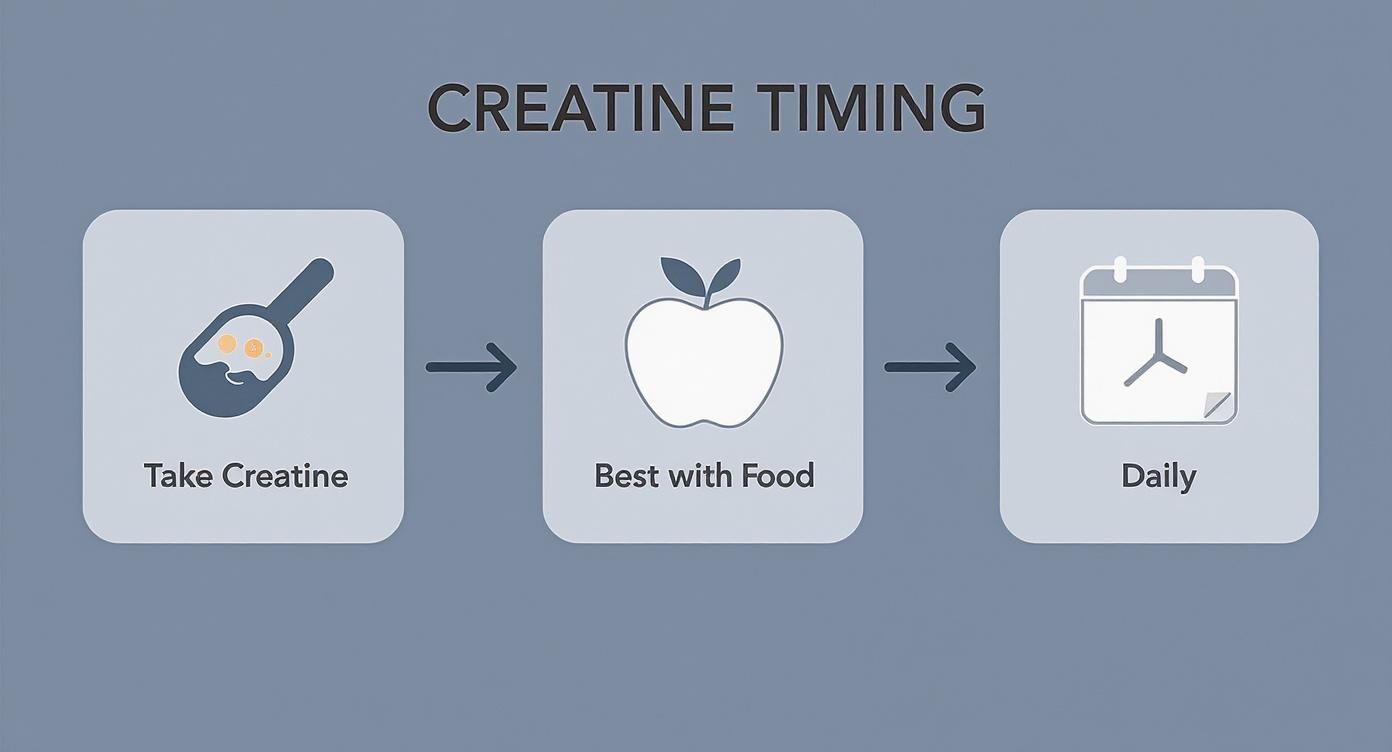
This visual gives you a clear hierarchy of what matters most: taking creatine is good, taking it with food is better, but taking it daily is best. Understanding how creatine works to fuel your body's energy systems is key, and it's also a powerhouse supplement when it comes to creatine for muscle recovery after a tough session.
Unlocking Your Muscle Cells With Insulin
So, how do we get that creatine delivery truck to its destination more efficiently? The secret is a hormone you're probably already familiar with: insulin.
When you eat a meal with carbs or protein, your body releases insulin. Think of insulin as the gatekeeper for your muscle cells. It unlocks the gates, signaling them to open up and pull in nutrients—like creatine—from your bloodstream. This is a fundamental part of muscle recovery and growth.

This insulin release directly affects those creatine transporters we talked about earlier. It essentially gives them a jolt, ramping up their activity and making them much better at shuttling creatine into your muscles.
How to Maximize Your Creatine Uptake
The result? A far more effective delivery system. By simply taking your creatine with a meal, you're not just getting calories; you're actively helping your muscles sponge up more creatine.
This supercharged uptake helps your muscles reach their saturation point faster. In practical terms, that means you'll start seeing and feeling the strength and performance benefits sooner.
Now, this doesn't mean you need to chug a sugary drink or eat a whole pizza to get this effect. A massive insulin spike isn't the goal. We're looking for a moderate, healthy response to do the job.
A simple, balanced meal is all you need. A post-workout shake with protein and a banana is perfect. Even your regular lunch of chicken and rice will create the ideal environment for creatine absorption.
If you want to dive deeper into this, check out our guide on taking creatine with carbs for more strategies. It’s a simple tweak, but coordinating your creatine with a meal is one of the easiest ways to get the absolute most out of every scoop.
Does Taking Creatine With Food Lead to Fat Gain?
https://www.youtube.com/embed/aU5PZcwMc7A
Let’s tackle one of the most common myths out there: the idea that taking creatine with a meal or a carb-based shake will make you gain unwanted body fat.
It’s easy to see where the concern comes from, but the fear is completely unfounded. The whole point of pairing creatine with food is simply to get it into your muscles more effectively—not to pile on a significant number of calories.
Think of the small calorie bump from your post-workout shake or meal as a strategic investment. Those calories are put to work, fueling your recovery and ensuring you get the absolute most out of every scoop. Any initial weight gain you see on the scale is from lean muscle mass and water weight inside the muscle cells, which is exactly what you want. It’s not fat.
Separating Fact from Fiction
The science on this is crystal clear. Study after study confirms that creatine supplementation helps you pack on muscle, not fat.
One trial followed a group of recreational bodybuilders who took 5 grams of creatine daily for eight weeks. The results? They gained an average of 1.3 kg in lean body mass, while their fat mass didn't change at all. You can dive into the full research on creatine and body composition to see the data for yourself.
The takeaway is simple: Creatine helps you build the physique you're working for by adding powerful, functional muscle. Taking it with food just makes it work better, without sabotaging your body fat goals.
Ultimately, any worries about this strategy causing fat gain are misplaced. If you want to dig deeper, our guide on whether creatine helps you lose fat breaks down its full impact on your overall body composition.
Simple Ways to Pair Creatine With Your Meals
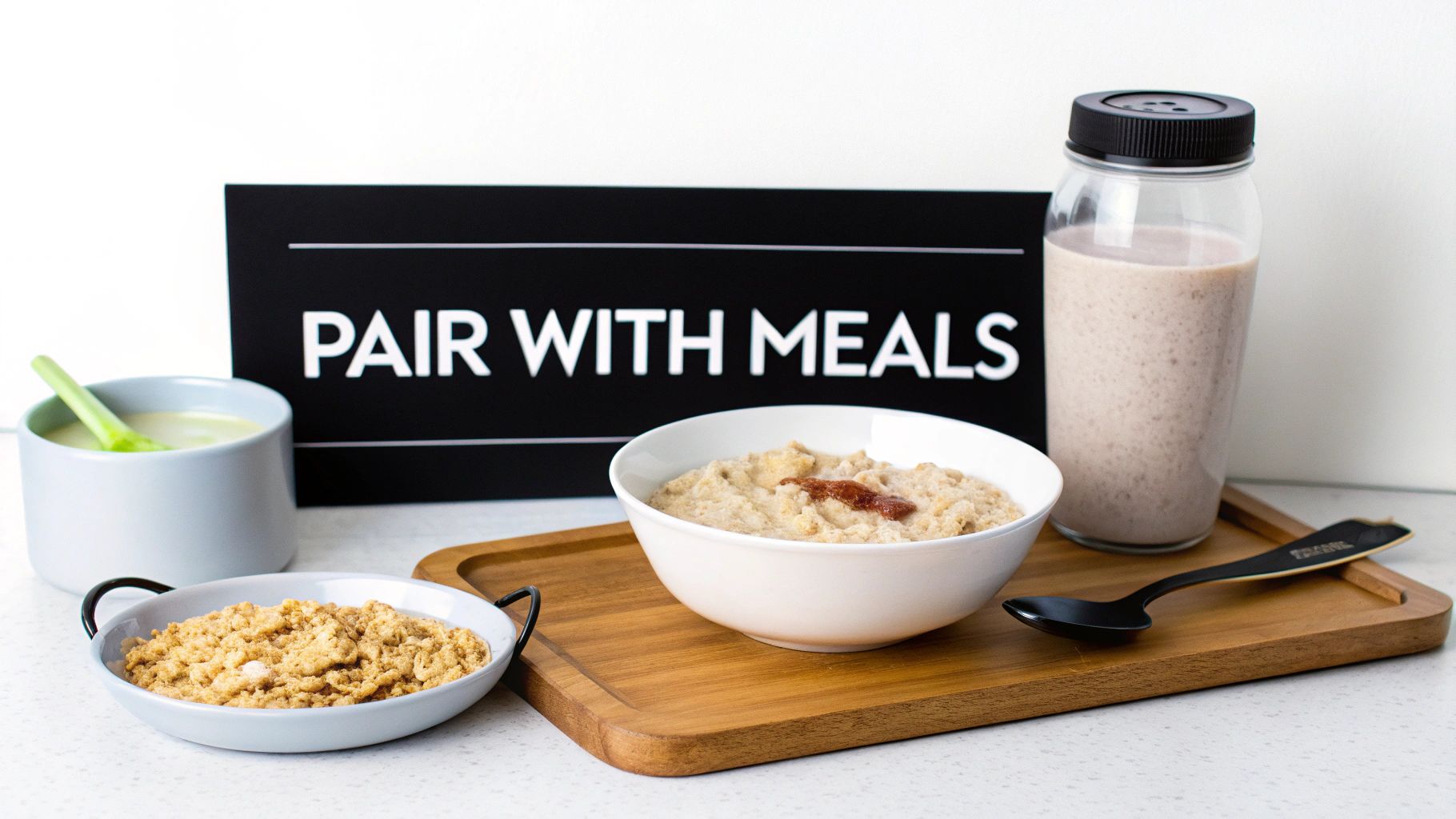
Knowing the science is one thing, but putting it into practice is what really counts. The good news is that weaving creatine into your daily meals isn't complicated. You don't need a complex strategy or a major lifestyle overhaul. The real goal is to make it a simple, automatic habit.
The most common form, creatine monohydrate, is virtually tasteless and dissolves easily in liquids. This makes it incredibly versatile—you can sneak it into almost anything without even noticing it’s there, which is a huge advantage for staying consistent.
Easy Meal and Snack Pairings
So, how do you actually do it? Here are a few dead-simple ways to take your creatine with food to get that helpful insulin response we talked about. These ideas work perfectly whether you're taking it pre-workout, post-workout, or just with a regular meal.
-
Morning Oatmeal or Yogurt: Kickstart your day by mixing your daily 3-5 grams of creatine straight into your oatmeal or a bowl of Greek yogurt. The carbohydrates from the oats and the protein in the yogurt create the perfect environment to help your body absorb it.
-
Post-Workout Protein Shake: This is a classic for a reason. After a tough session, your muscles are like sponges, ready to soak up nutrients. Tossing creatine into your post-workout shake with protein powder and a fast-acting carb like a banana is a highly effective strategy.
-
Fruit Smoothies: Not a big fan of protein shakes? No problem. A fruit smoothie does the trick just as well. Blend your creatine with fruits like pineapple, mango, and a handful of spinach for a nutrient-dense option. The natural fruit sugars will give you that gentle insulin spike to help with transport.
The best method is the one you can stick to without thinking. Find a meal or snack you have every day and simply make creatine a part of that routine. Consistency is what drives results.
If you want to explore even more options, our guide on what to take with creatine has plenty of other combinations to keep things interesting. At the end of the day, the perfect pairing isn't about complexity—it's all about consistency.
Common Questions About Creatine and Food
Even when you have a solid plan, a few questions always pop up as you dial in your supplement routine. Let's tackle some of the most common ones about taking creatine with food, so you can feel completely confident in your approach.
What Happens If I Take Creatine on an Empty Stomach?
Taking creatine on an empty stomach is absolutely fine—your body will still absorb it and put it to work. The main reason we talk about pairing it with food is to get that small efficiency boost from the insulin response.
That said, a small number of people might notice minor stomach discomfort or bloating when they take it without a meal. If that sounds like you, the easy fix is to just have it with food. At the end of the day, consistency is what matters most. If taking it on an empty stomach works for your schedule and feels fine, stick with it.
Do I Need a Specific Amount of Carbs With My Creatine?
No, you definitely don't need to slam a bunch of sugary foods. While some of the older studies used massive doses of simple carbs—sometimes up to 100 grams—to get the biggest insulin spike possible, we now know that's overkill. A more realistic approach works just as well.
Simply taking your daily creatine with a normal, balanced meal that has a standard serving of carbs (think rice, potatoes, or a piece of fruit) is more than enough to help with absorption.
The goal is to give your creatine transporters a gentle nudge, not a massive sugar rush. A simple post-workout shake with 30-50g of carbs and some protein is a perfect and highly effective strategy.
Is It Better to Take Creatine Before or After My Workout?
The whole pre- versus post-workout creatine debate has been going on for years, but the science is pretty clear: the difference is minimal. The most important thing is simply keeping your muscles saturated with creatine, which comes from consistent, daily intake, not from nailing the perfect timing.
However, there is some evidence that suggests a slight edge for taking it post-workout. In that recovery window, your muscles are like sponges, soaking up nutrients to replenish energy and kickstart the repair process.
A super convenient and effective strategy is to just mix your creatine into your post-workout shake. This lets you knock out a few goals at once:
- Replenishes creatine stores when your muscles are most receptive.
- Delivers protein to get a head start on muscle repair and growth.
- Provides carbohydrates to restock your glycogen levels.
Ultimately, the best time to take creatine is whenever you'll remember to do it consistently. Don't sweat the small details of timing and lose sight of the main goal: daily use.
For a delicious and incredibly convenient way to get your daily 5g of creatine without the mess of powders, check out Smash.com's creatine gummies. They make consistency effortless and enjoyable. Learn more at https://smash.com.


