

Creatine and Endurance Running Guide
The short answer? Yes, creatine can absolutely help endurance runners, just not in the way most people assume. It won't directly fuel your long, steady miles, but think of it more like a secret weapon for those make-or-break moments: hills, surges, and that final push to the finish line.
The Truth About Creatine for Endurance Runners
For years, creatine got stuck with a reputation as a "bodybuilder-only" supplement—something for powerlifters looking to pack on muscle. This stereotype has scared off countless runners who worried it would make them bulky or cause cramps. But modern science paints a much different picture, showing that its role in energy production offers some surprisingly powerful perks for anyone logging serious mileage.
Here's a simple way to look at it. Your long runs are fueled almost entirely by your aerobic system, which is a slow-and-steady engine that uses oxygen to burn fats and carbs. It's built for marathon-level efficiency. Creatine, on the other hand, is high-octane fuel for your anaerobic system—the one that kicks in for short, explosive efforts lasting just a few seconds.
So, how does a "sprinter's supplement" help a marathoner? The magic isn't in making your easy pace faster. It's all about supercharging your ability to handle the tough, high-intensity moments within a long run or race.
The Real Value for Runners
The link between creatine and endurance running is all about boosting the quality of your training and giving you an edge on race day. By topping off your tank for those quick, powerful bursts, creatine supplementation can lead to some serious performance gains.
This is what it looks like out on the road:
- Stronger Surges: When you need to pass a competitor or break away from the pack, creatine delivers the instant energy needed for that sharp acceleration.
- Powering Up Hills: Tackling a steep hill requires a quick blast of power. Higher creatine stores help you attack inclines without totally gassing yourself.
- A Killer Finishing Kick: That all-out sprint to the finish line is a classic anaerobic effort. Creatine can give you that extra gear when everyone else is fading.
- Better Training Sessions: It lets you push harder during interval workouts, track repeats, and hill sprints—the very workouts that build speed and improve your running economy.
By sharpening your performance in these crucial, race-defining moments, creatine acts as a powerful support tool, not a primary fuel. It raises your performance ceiling, which allows all your hard-earned endurance to truly shine.
To put it simply, the goal isn't to change how you run your easy miles. It's to arm you with the explosive power you need to conquer the toughest parts of any course.
Let's break down how creatine specifically benefits long-distance runners in a quick-reference table.
Creatine's Impact on Endurance Running At a Glance
The table below summarizes the key ways creatine supplementation can support your running, highlighting its primary and secondary effects.
| Area of Impact | Effect on Endurance Running | Best For |
|---|---|---|
| High-Intensity Bursts | Directly fuels short, powerful efforts like sprints and hill climbs by rapidly regenerating ATP (energy). | Runners looking to improve their finishing kick, surge capacity, or interval training performance. |
| Training Quality | Allows you to complete more reps or maintain a higher intensity during speed workouts and hill repeats. | Athletes focused on structured training plans with high-intensity interval training (HIIT) sessions. |
| Muscle Recovery | May reduce muscle damage and inflammation post-exercise, leading to faster recovery between tough workouts. | Runners who struggle with soreness or need to bounce back quickly for their next training session. |
| Cellular Hydration | Pulls water into muscle cells, which can help with thermoregulation and potentially reduce cramping risk. | Runners training in hot or humid conditions, or those prone to exercise-induced cramps. |
As you can see, the benefits go beyond just raw power, touching on recovery and even cellular hydration.
Ultimately, this strategic advantage is what makes creatine such a valuable—and often overlooked—supplement for the modern runner. To get a deeper look at how it works across different types of workouts, check out our detailed guide on creatine and cardio. This article will break down the science, bust the common myths, and give you a clear roadmap for using it to your advantage.
How Creatine Fuels High-Intensity Running Efforts
To really get how creatine helps an endurance runner, we first need to peek under the hood at how our bodies produce energy. Let's skip the dense biology textbook explanation.
Think of your muscle's go-to energy source, adenosine triphosphate (ATP), like a smartphone with a tiny, built-in battery. It delivers a powerful jolt of energy, but it dies almost instantly—we're talking just a few seconds of all-out effort.
This ATP is the only fuel your muscles can use directly. Every time you push off the ground, surge up a hill, or break into a sprint, it's ATP that's making it happen. The problem is, you just don't have much of it stored in your muscles at any given moment.
Once that little battery is dead, your body has to recharge it, and it needs to happen fast. This is where creatine makes its grand entrance.
The Power Bank for Your Muscles
Your body stores most of its creatine in the muscles as phosphocreatine (PCr). If ATP is the smartphone, think of phosphocreatine as the portable power bank you carry around to recharge it.
When you use ATP, it breaks down into adenosine diphosphate (ADP)—essentially a dead phone battery. Phosphocreatine is the hero of the moment. It swoops in, donates its phosphate group to that dead ADP, and instantly turns it back into a fully charged ATP molecule.
This whole process is incredibly quick, giving you a rapid-fire supply of energy for high-intensity efforts lasting up to about 10 seconds. It's the go-to energy system for sprinters and weightlifters.
So, what does this "sprint" system have to do with running a marathon? The magic lies in realizing that even the longest race isn't just one long, steady jog. It's actually a series of smaller, more intense challenges strung together.
By stocking up your muscles with phosphocreatine, creatine supplementation is like giving yourself a bigger, better "power bank." This lets you regenerate ATP faster right when it counts, helping you crush those make-or-break moments in a race.
Applying Anaerobic Power to an Aerobic Sport
While your aerobic system is the main engine fueling most of your run, your anaerobic system—powered by ATP and phosphocreatine—takes the wheel every time you hit a high-intensity patch.
And these moments happen way more often than you'd think:
- Attacking a Hill: That steep, 30-second climb demands a massive power output that your aerobic system simply can't generate quickly enough.
- Surging Past a Competitor: Making a decisive move to pass someone or responding to their pace change is a short, sharp burst of speed.
- Navigating Tricky Terrain: Hopping over roots or making quick cuts on a trail requires fast, powerful muscle contractions.
- The Finishing Kick: That classic, all-out 200-meter sprint to the finish line is fueled almost entirely by this immediate energy system.
Without enough phosphocreatine, your body has to rely more on glycolysis, another anaerobic system that produces lactate. While lactate isn't the villain it was once made out to be, its buildup is linked to that all-too-familiar muscle burn and fatigue that forces you to slow down.
Having more creatine "power banks" means you can handle these short bursts more effectively, holding off fatigue and saving your precious glycogen stores for later. This infographic sums up the key benefits perfectly.
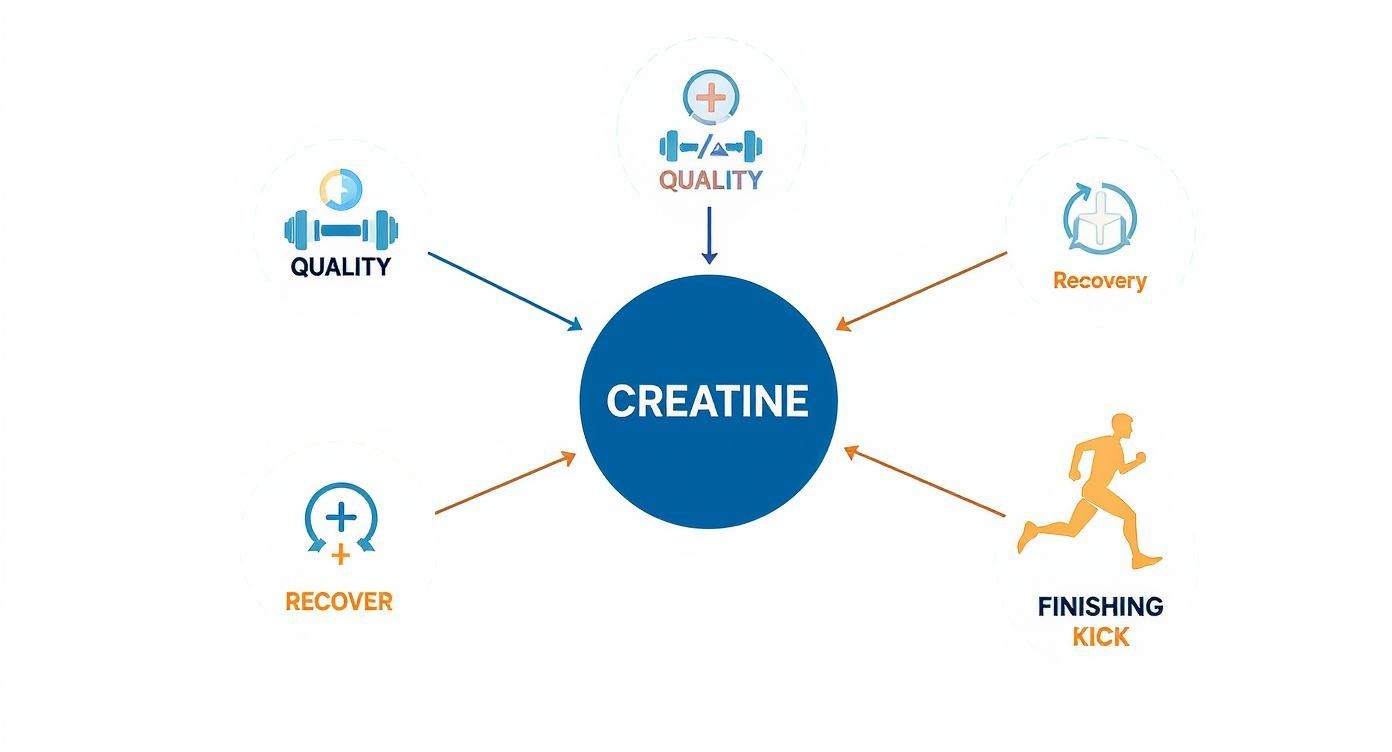
As you can see, the value of creatine for runners isn't just about a single effort; it's about improving your training, speeding up recovery, and delivering that strong finish.
Beyond the Turbo Boost
But the benefits don't just stop with that immediate energy boost. Topping off your creatine stores offers some other advantages that are incredibly valuable when looking at the connection between creatine and endurance running.
For one, research suggests creatine can help you store more muscle glycogen. When you take creatine along with carbohydrates, your muscles can pack away more of your primary long-distance fuel. That could mean having more in the tank for those tough final miles.
Creatine also draws water into your muscle cells in a process called cellular hydration. This super-hydrated state isn't just great for helping you stay cool on hot runs; it can also support muscle repair and reduce protein breakdown, leading to better recovery and adaptation from all your hard work.
Real Performance Gains for Long-Distance Runners

So, we've covered the science. But what does all that actually mean for your performance on the road or trail? When you connect the dots between creatine and endurance running, the real magic happens during the moments that make or break a race.
Creatine isn’t really about making your easy Sunday long run feel easier. It’s about arming you with more horsepower and grit when the effort level skyrockets. Let's look at the three main ways runners see real, measurable improvements.
A Stronger Finishing Kick and Surge Capacity
Picture this: you're at mile 12 of a half marathon, and the finish line is agonizingly close. Your legs feel like lead, but you spot a competitor just ahead. This is creatine's time to shine.
Having deeper reserves of phosphocreatine means you have instant access to that explosive, high-octane energy needed to shift gears.
Instead of just gritting your teeth and holding on, you can actually launch a real surge to pass that runner or hammer home a powerful finishing kick in the final 200 meters. It’s the difference between just finishing and finishing strong. This same advantage comes into play mid-race, too—whether you're responding to a sudden pace change from the pack or powering over a short, punchy hill without going into the red.
Understanding the specific demands of events, such as when preparing for a half marathon, helps you see exactly where these power-based benefits can be a game-changer.
Enhanced Recovery and Reduced Muscle Damage
One of the most overlooked perks of creatine for runners is how it helps you bounce back. Every tough workout—track repeats, a hard tempo, or a hilly long run—creates tiny tears in your muscle fibers. That’s a good thing; it's how you get stronger.
The problem is, too much damage without enough recovery leads straight to burnout, nagging soreness, and overtraining. Creatine steps in by helping to buffer some of that exercise-induced damage and cool down inflammation.
This means you might feel noticeably less sore the day after a hard session. You can get back to quality training faster. Over an entire training cycle, this benefit really starts to add up, letting you handle more intensity and volume without constantly feeling beaten down. For more ideas on how to support your training, check out our guide on the best supplements for endurance.
Key Takeaway: Faster recovery isn't just about comfort. It's a strategic advantage that allows you to stack more high-quality workouts together, leading to bigger fitness breakthroughs over time.
For any runner pushing their limits, this ability to recover faster is crucial for staying consistent and injury-free.
Improved Training Quality Drives Overall Endurance
At the end of the day, how you race is a direct reflection of how you train. This is where creatine’s ability to fuel intense efforts completely changes the game for your endurance. By helping you push harder in those key workouts, it raises your entire fitness ceiling.
Think about these bread-and-butter training sessions:
- Track Intervals: Instead of your form falling apart on the last few 400-meter repeats, you can hold your pace and finish strong.
- Hill Repeats: You can attack each climb with more power, which builds serious strength and improves your overall running economy.
- Tempo Runs: Having the gas to surge or nail the final mile of a tempo run builds both physical and mental resilience.
By elevating your performance in these workouts, you're essentially building a bigger and more powerful aerobic engine. The speed and lactate threshold you develop in training are what translate directly to a faster, more sustainable pace on race day.
The latest research confirms this. A 2023 study on competitive triathletes discovered that just five days of creatine loading led to an incredible 18% increase in power output during repeated sprints embedded within a long cycling test. You can explore the full study on creatine's effects on intermittent sprints to see the data for yourself.
Simply put, creatine helps you make your hard days harder, which ultimately makes your race day feel easier.
Busting Common Creatine Myths for Runners

Creatine has been around for decades, but it's still dogged by myths that mostly come from its early days in bodybuilding locker rooms. These old ideas just don't stack up against what we know today, and they often scare runners away from a genuinely useful tool.
Let's cut through the noise and get to the truth behind the biggest concerns.
Myth 1: Creatine Causes Cramping and Dehydration
This is probably the most common fear I hear from endurance athletes. The logic seems to make sense at first glance: creatine pulls water into your muscles, so it must be leaving the rest of your body high and dry, right? Wrong.
In reality, creatine enhances your overall hydration. By increasing the water content inside your muscle cells, it creates a better-hydrated state that can actually improve your body's ability to regulate its temperature. Think of it as giving your muscles their own internal reservoir, which is a huge advantage on hot days.
Countless studies have looked for a link between creatine and cramping or dehydration, and they've consistently come up empty. Athletes using creatine aren't at any higher risk, as long as they're drinking enough water.
The real culprit behind cramping isn't creatine; it's dehydration itself. If you're maintaining good hydration habits—which every runner should be doing anyway—creatine is far more likely to help your fluid balance than hurt it.
Myth 2: Creatine Will Make Me Bulky and Slow
The fear of packing on unwanted weight is real for any runner. You see "creatine," and you picture a massive bodybuilder, but that's not how it works for endurance athletes.
Yes, you might notice the scale jump up by 2-4 pounds in the first week. But this isn't fat or even pure muscle. It's just the water weight from creatine doing its job and hydrating your muscle cells. This initial fluid gain is temporary and usually much less noticeable for runners, who typically have a leaner build than powerlifters.
After that first week, any weight you gain is hard-earned lean muscle from your training, not from the powder itself. The performance boost you get from better training capacity and more power will almost certainly outweigh any minor blip on the scale.
Myth 3: Creatine Is Only for Bodybuilders
This is the original stereotype, and it's long overdue for retirement. While creatine is fantastic for anyone chasing a new PR on the bench press, its core function—rapidly recycling energy—is universal.
Think about all the times you demand a sudden burst of power during a run. Creatine is tailor-made for those moments.
- Hill Sprints: It helps you power up steep inclines without fading.
- Track Intervals: It gives you the pop you need to hit your splits consistently.
- Finishing Kicks: It's the fuel for that final all-out sprint to the finish line.
Seeing creatine as just a "bulk-up" supplement is missing the bigger picture. For a runner, it's a tool for improving the quality of your hardest workouts. It helps you become a stronger, more powerful, and more resilient athlete, not just a bigger one.
How to Use Creatine for Running Performance
Alright, so we've covered the science. Now for the important part: how do you actually use creatine to get an edge in your running? Making it work is all about smart, consistent application. Here’s your practical playbook for getting it right, from picking the best type to locking in your daily dose.
First, let's keep it simple. The best, most proven, and most affordable form of creatine is creatine monohydrate. You’ll see fancier, more expensive versions out there, but monohydrate is the one that nearly all the solid scientific research is built on. It's the gold standard for a reason.
Choosing Your Dosing Strategy
When it comes to how much to take, runners have two main paths to choose from. The one you pick really boils down to how fast you want to see results and what feels easiest for you to stick with. Neither one is technically "better" than the other—it's all about what syncs up with your training and lifestyle.
You can either go for the "loading phase" to get results faster or take the slower, steadier "maintenance" approach.
- The Loading Phase: Think of this as the fast track. The goal is to fully saturate your muscles with creatine as quickly as possible, usually in about a week. You’ll take a higher dose for a few days before tapering down to a smaller daily amount for the long haul.
- The Maintenance Dose: This is the simpler, more gradual route. You just skip the high-dose week and start right away with the standard daily amount. It’ll take longer to reach full saturation—about three to four weeks—but it’s incredibly straightforward and easier on the stomach if you’re sensitive.
If you really want to get into the weeds on these methods, our comprehensive creatine dosage guide breaks down everything you need to know.
Creatine Dosing Protocols For Runners
To make the choice crystal clear, let's put these two popular strategies side-by-side.
| Protocol | Daily Dosage | Duration | Pros | Cons |
|---|---|---|---|---|
| Loading Phase | 20 grams total (split into four 5g doses) for the first 5-7 days. | 5-7 days, followed by maintenance. | Fastest way to saturate muscles and experience benefits. | Can be inconvenient to split doses; higher initial amount may cause mild GI issues for some. |
| Maintenance Dose | 3-5 grams per day. | Ongoing. | Simple, easy to remember, and very gentle on the digestive system. | Takes longer (3-4 weeks) to reach full muscle saturation and see maximum benefits. |
Deciding between the two really comes down to your personal timeline and preference.
For most endurance runners, jumping straight into a maintenance dose of 3-5 grams per day is the most practical and sustainable way to go. Unless you have a huge race coming up in less than a month, the slightly longer wait for full saturation won't make a meaningful difference.
Nailing Your Timing for Best Results
Okay, you've picked your dose. So, when should you actually take it? While being consistent every day matters way more than the exact time on the clock, a little bit of smart timing can help you get the most out of every scoop.
The main idea is to help your muscles absorb the creatine as effectively as possible. We have good research showing that taking creatine along with carbohydrates (and sometimes protein) boosts its uptake. Why? The insulin released in response to the carbs acts like a key, helping to shuttle more creatine into your muscle cells.
This makes the post-workout window the perfect time for your daily dose.
Try mixing your 3-5 grams of creatine into your recovery shake or having it with a carb-heavy snack after your run. This timing capitalizes on the fact that your muscles are primed to soak up nutrients after exercise. It slots perfectly into a recovery routine you already have, making it a super easy habit to build.
And on rest days? No need to overthink it. Just take it with any meal that has some carbs.
So, What's the Final Word on Creatine for Endurance?
When you lay all the evidence out, the picture becomes pretty clear. Creatine isn't some magic potion that's going to directly power you through a 20-miler. But it's also a huge misconception to think it's just for bodybuilders trying to bulk up.
Think of it less as your main fuel tank and more like a turbo-boost button in your nutritional toolkit. It’s a strategic asset you can use to sharpen your performance, improve the quality of your training, and ultimately gain a real competitive edge when it counts.
Key Takeaways for Runners
For endurance athletes, creatine’s real magic happens in those short, intense bursts that can make or break a race.
- Powerful Surges: It’s the secret weapon for your anaerobic system. This means more power when you’re attacking a hill, making a decisive move to break away from the pack, or unleashing that final finishing kick.
- Better Training Quality: By allowing you to push harder during tough interval sessions and repeats, you’re actually building a higher lactate threshold and improving your overall running economy. The work gets harder, and you get better.
- Quicker Recovery: Creatine helps reduce muscle damage and cool down inflammation. This means you can bounce back faster between those leg-burning workouts, leading to more consistent, high-quality training.
In the end, creatine has absolutely earned its spot as a smart, versatile tool for the modern runner. It’s all about supporting the powerful, explosive efforts that forge a stronger, faster, and more resilient athlete.
If your training involves any kind of strength work, track intervals, or if you just want to have more in the tank for that final sprint to the finish line, creatine is a proven supplement that's seriously worth considering. It’s not about getting bigger; it's about getting more powerful. By understanding how it works, you can decide if it's the right tool to help you go out and crush your next running goal.
Common Questions Answered
Alright, even after digging into the science, you probably still have a few questions rolling around in your head. That’s completely normal. Let's tackle the most common concerns I hear from runners about using creatine.
Will Creatine Wreck My Hydration on a Long Run?
This is a big one, and for good reason—marathoners live and die by their hydration strategy. The myth that creatine causes dehydration or cramping is based on a big misunderstanding of how it actually works.
Creatine monohydrate is a bit of a water magnet, but it pulls water into your muscle cells. Think of it as improving your muscles' own internal hydration. This isn't stealing water from the rest of your body; it's simply creating a more hydrated, resilient environment inside the muscle tissue, which can actually help with performance.
As long as you stick to your normal, solid hydration plan—drinking plenty of fluids throughout the day and during your runs—creatine won't cause problems. It works with your body's fluid balance, not against it.
Do I Need to Cycle On and Off Creatine?
Nope. The short and sweet answer is no.
The whole "cycling" concept comes from old-school supplements that could mess with your body's natural hormone production. Creatine isn't like that at all. Your body keeps making its own creatine whether you supplement or not; taking extra just tops off your muscle stores for better performance.
Decades of research have shown that taking 3-5 grams daily, long-term, is perfectly safe for healthy people. There's zero benefit to stopping. In fact, if you did, your muscle creatine levels would just slowly drift back down to your normal baseline over a few weeks.
When Is the Best Time to Start Taking Creatine?
Timing is crucial in any training plan, and adding a new supplement is no different. The absolute worst time to start is the week of your A-race. You never, ever want to introduce a new variable right before you toe the line.
The sweet spot is during your off-season or early in a base-building phase. Starting then gives you a few major wins:
- Time to Adapt: It gives your body a month or more to fully saturate your muscles and get used to any minor initial water retention, all without the pressure of an upcoming race.
- Boost Your Training: You'll get the benefits during your most important training blocks, helping you power through those tough interval sessions and strength workouts that really move the needle.
- Race-Day Confidence: By the time your big day arrives, creatine is just a normal, boring part of your daily routine, not some last-minute experiment.
For over 25 years, the research has been incredibly consistent: creatine is a safe and effective tool for boosting high-intensity efforts, especially those lasting less than 30 seconds. While it won't directly fuel your marathon pace, its power to support that final kick to the finish line is undeniable, making it a smart play for any competitive runner. Learn more about the 25 years of creatine research.
Ready to elevate your training with the most convenient and delicious creatine on the market? Smash.com offers premium creatine gummies that make daily supplementation effortless and enjoyable. Ditch the messy powders and fuel your next personal best by visiting https://smash.com to get started.


