

Difference Between Micronized Creatine and Creatine Monohydrate: Key Insights
The main difference between micronized creatine and creatine monohydrate comes down to one thing: particle size. Micronized creatine is just creatine monohydrate that has been mechanically milled into a much finer powder. This process doesn't alter the creatine molecule, but it significantly improves how well it dissolves in liquid.
The result? A smoother drink and, for many people, a more comfortable digestive experience.
A Quick Guide to Creatine Forms
Think of micronized creatine as a refined version of the classic, tried-and-true creatine monohydrate. The actual compound that helps you build muscle and boost performance is exactly the same in both. The extra processing step for micronized creatine is designed to tackle common complaints about the standard form, like that gritty texture at the bottom of your shaker or occasional stomach discomfort.
This infographic breaks down the key distinctions in particle size, how well they dissolve, and what you can expect to pay for each.
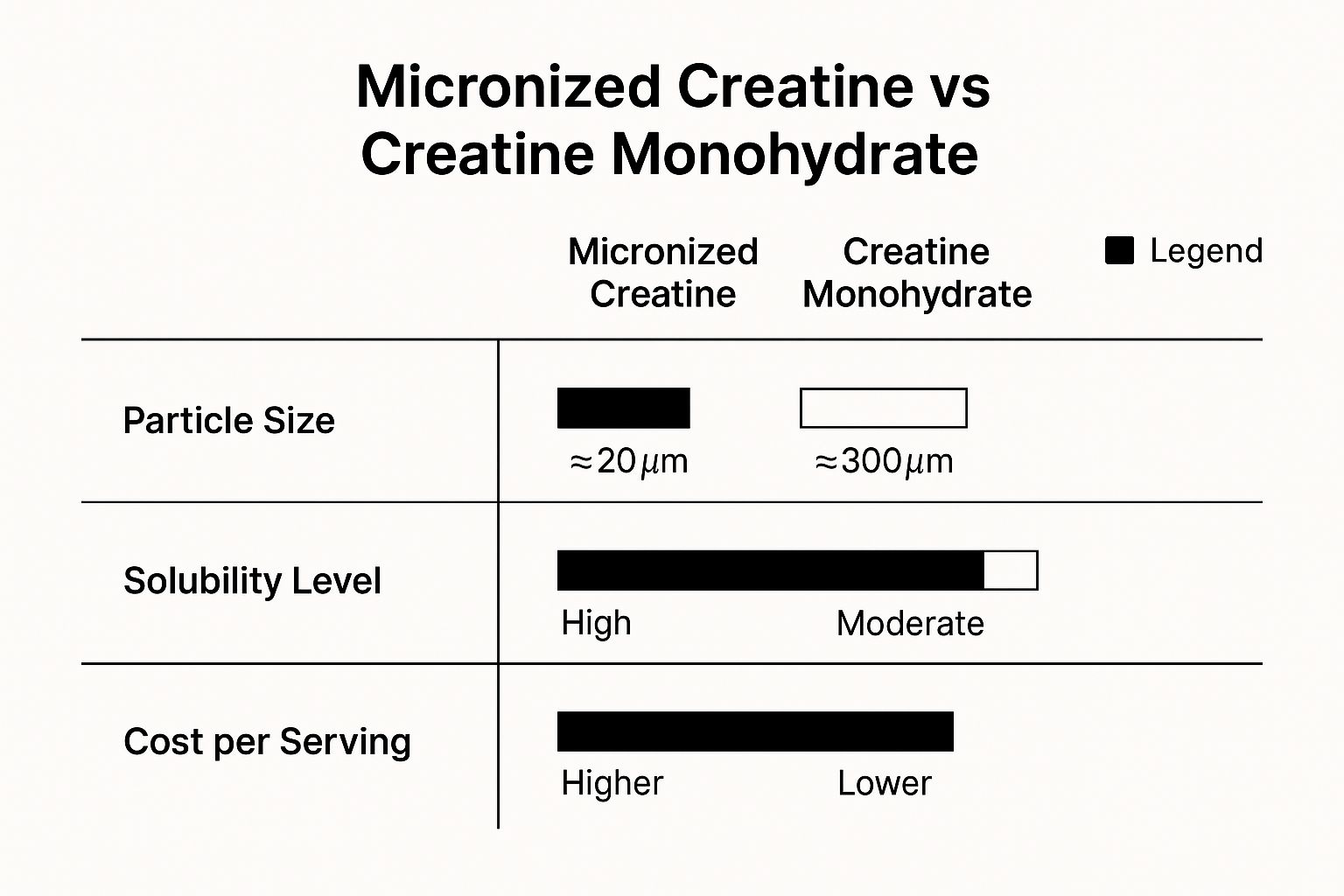
As you can see, the smaller particles of micronized creatine mix up much better but come at a slightly higher price. To give you a clearer picture, here’s a quick side-by-side breakdown.
Key Differences Between Creatine Forms
This table offers a snapshot of the practical differences between standard creatine monohydrate and its micronized version, helping you decide which is a better fit for your routine.
| Feature | Creatine Monohydrate | Micronized Creatine |
|---|---|---|
| Particle Size | Larger particles that can take longer to dissolve. | Up to 20x smaller particles for enhanced mixing. |
| Mixability | Decent, but often leaves a sandy or gritty residue. | Excellent; dissolves quickly and completely for a smooth mix. |
| Absorption | Highly effective, but slower dissolution might affect speed. | Potentially faster absorption due to the increased surface area. |
| Digestive Comfort | May cause bloating or an upset stomach for some people. | Generally much easier on the stomach and less likely to cause issues. |
| Cost | The most budget-friendly and widely available option. | Slightly more expensive because of the extra processing step. |
Ultimately, this comparison shows that the choice isn't about which one is "better" for building strength and muscle—they both work. It really boils down to your personal preference for mixability and whether you have a sensitive stomach.
Understanding Creatine Monohydrate: The Gold Standard

Creatine monohydrate is, without a doubt, the undisputed champion of sports supplements. It’s earned the title "gold standard" not through clever marketing, but through decades of solid scientific research. It is hands-down the most studied form of creatine on the planet and the bedrock of everything we know about how this compound works.
When you see headlines about creatine boosting strength or packing on muscle, the research behind those claims almost always used creatine monohydrate. This long track record gives it a level of trust that newer, fancier forms just haven't earned yet. It’s the go-to for athletes and gym-goers because it simply works.
The Foundation of Performance
At its core, creatine monohydrate's chemical stability and purity make it incredibly effective. It functions by topping off your muscles' phosphocreatine stores, which is the high-octane fuel your body needs for short, explosive efforts like lifting heavy weights or sprinting.
This direct line to your energy production system is why it’s a non-negotiable staple for anyone serious about their training. The results are clear, proven, and backed by a mountain of evidence from both the lab and the real world.
Creatine monohydrate sets the benchmark for efficacy. Its simple, stable structure has been the subject of hundreds of clinical trials, making it the most trusted and scientifically validated sports supplement available for improving strength and performance.
Unmatched Scientific Backing
The sheer volume of research is what really puts creatine monohydrate in a league of its own. In fact, over 90% of all published studies on creatine's effectiveness used this specific form, creating an incredible evidence base.
Time and again, clinical trials show it can increase muscle creatine stores by 10–40% and improve strength and power output by a significant 5–15%. If you want to dive deeper into the numbers, the market analysis of creatine monohydrate's impact paints a clear picture.
This is why the debate between micronized creatine and creatine monohydrate often boils down to personal preference and user experience, not a difference in results. Monohydrate remains the reliable, foundational choice.
What Is Micronized Creatine? The Refined Alternative

Micronized creatine isn’t some new, exotic form of creatine. It’s simply creatine monohydrate that has gone through an extra processing step to make it more user-friendly. The performance-boosting molecule is exactly the same, but its physical structure has been refined.
The magic happens through a mechanical process called micronization. Here, standard creatine monohydrate crystals are ground down into particles up to 20 times smaller. This creates a super-fine powder with a much greater surface area, which directly addresses some of the most common complaints about the original formula.
Better Solubility and a Smoother Mix
The most noticeable upgrade is how well it dissolves. Those tiny particles mix into liquid far more easily and completely, getting rid of that gritty, sandy texture many people associate with standard creatine. You won't find that layer of sediment at the bottom of your shaker bottle.
This improved mixability makes for a much smoother drink. For anyone sensitive to texture, this is a huge plus and makes daily supplementation far more pleasant. In essence, the key difference between micronized creatine and creatine monohydrate comes down to this improved user experience.
The smaller particle size of micronized creatine not only improves how it mixes but may also lead to faster absorption and reduced stomach discomfort, making it a preferred choice for individuals with sensitive digestive systems.
A Gentler Option for Your Stomach
That faster-dissolving nature also leads to another major benefit: it's often easier on the gut. Some people experience bloating or stomach cramps with standard creatine monohydrate, which can be due to the larger, undissolved particles sitting in their stomach.
Because micronized creatine gets into your system more quickly and completely, it’s less likely to cause that kind of digestive upset. This makes it a great choice for anyone who has had stomach issues with creatine in the past, allowing them to get all the benefits without the discomfort.
Comparing Performance, Solubility, and Side Effects
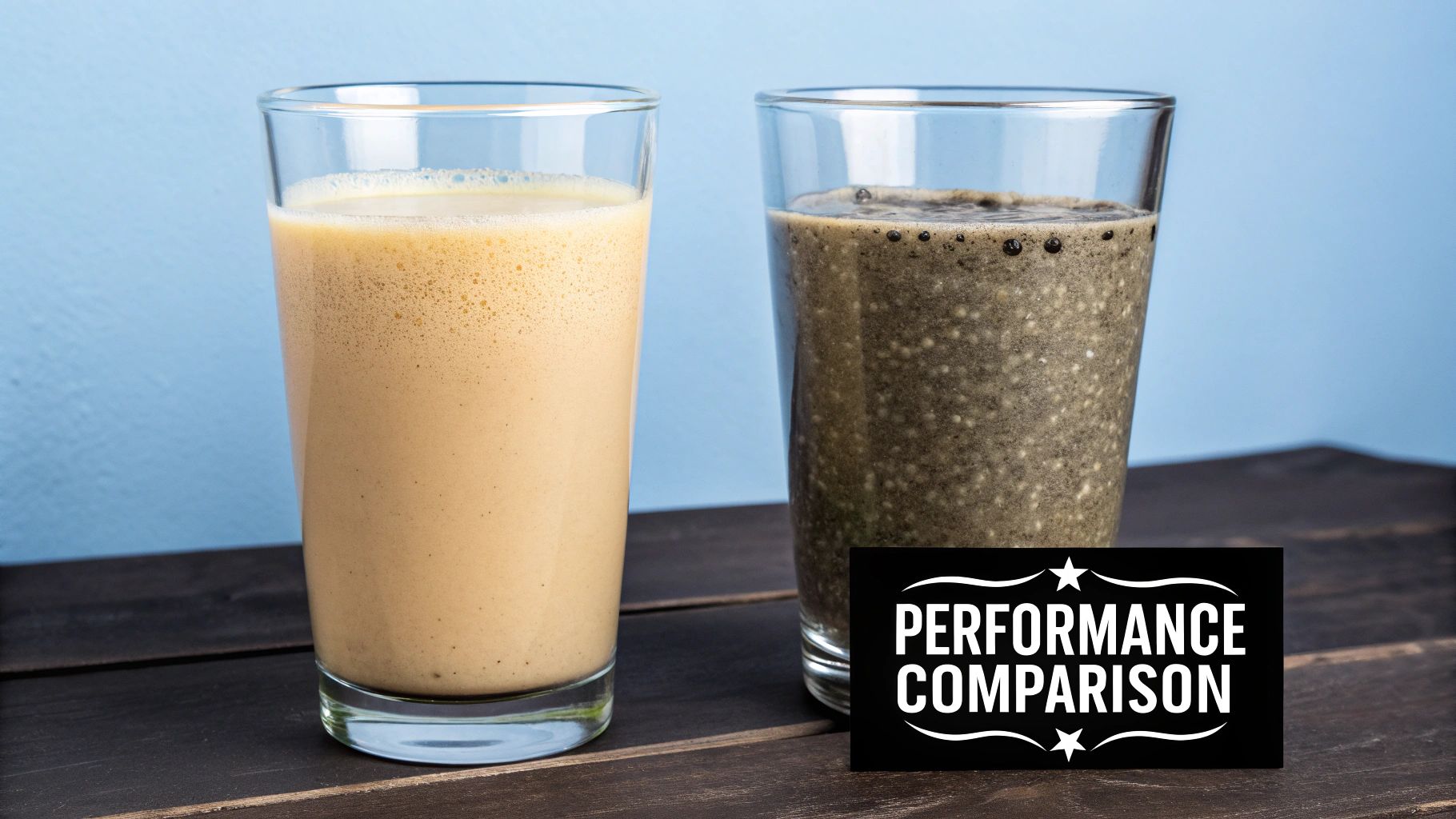
When you get down to the real-world difference between micronized creatine and creatine monohydrate, a few key distinctions pop up. Both will get you the strength and muscle gains you’re after, but how they act in your shaker cup and your stomach can be a totally different story.
The first thing you’ll notice is solubility. Standard creatine monohydrate is notorious for its larger particles. They often refuse to dissolve completely, leaving that gritty, sandy sludge at the bottom of your glass. Let's be honest, it’s not the most pleasant texture to chug down.
Micronized creatine, on the other hand, has ultra-fine particles that mix into water or juice almost instantly. This means you get a much smoother, more palatable drink, which makes taking it every day a whole lot easier.
Absorption and Efficacy in Muscle Cells
So, does mixing better actually lead to better results in the gym? It's a fair question. Because it has a greater surface area, micronized creatine can be absorbed from your gut into your bloodstream faster. This quicker uptake is a big plus for avoiding stomach issues.
But when we're talking about pure performance and muscle saturation, the differences mostly disappear. Both forms are incredibly effective at boosting phosphocreatine stores in your muscles. Once that creatine molecule is absorbed—whether it started big or small—it does the exact same job.
The bottom line on efficacy is simple: Both micronized and standard monohydrate are equally effective for building strength and muscle. The choice really comes down to user experience, not performance outcomes.
Impact on Digestive Side Effects
This is where micronized creatine really pulls ahead for a lot of people. The most common complaints with standard creatine monohydrate are gastrointestinal issues—bloating, stomach cramps, and general discomfort. This usually happens because undissolved creatine particles sit in your intestines and draw water in.
Since micronized creatine dissolves so well, it’s far less likely to cause this kind of digestive nightmare. If you have a sensitive stomach, it’s the clear winner. For anyone who's struggled with discomfort, it's worth finding a creatine that won't cause bloating.
This improved digestibility lets you reap all the performance rewards without the nasty side effects. Ultimately, the decision is about balancing cost with your own personal comfort and convenience.
Price and Availability: What's the Real Difference?
Let's talk brass tacks. When you're standing in the supplement aisle (or browsing online), two things probably jump out: the price tag and how many options you have. The difference between micronized and standard creatine monohydrate really boils down to an extra step in the manufacturing process—and you pay for that step.
Creatine monohydrate is, hands down, the most budget-friendly sports supplement out there. It's simple to make, which means it has the lowest cost per gram. This makes it the undisputed king for anyone on a tight budget or just starting out with creatine. It’s absolutely everywhere, sold by virtually every brand you can think of.
Micronized creatine, on the other hand, is marketed as the premium version. That extra milling process adds to the production cost, so you can expect to pay a bit more—usually around 10-20% more per serving. While it's still an affordable supplement, that small premium can add up over the long haul.
Finding Your Fit in the Market
Because of its long track record and low price, standard creatine monohydrate absolutely dominates the market. You can't miss it. It’s in specialty shops, big-box stores, and all over the internet. If you need help sifting through the noise, our guide to finding the best creatine brand can point you in the right direction.
Micronized creatine is also easy to find, but it’s not quite as universal. Fewer brands carry it, and it's often sold as an "upgraded" option rather than the standard.
The creatine market is massive and still growing, with projections hitting USD 4.21 billion by 2030. Powdered forms—which include both monohydrate and micronized versions—account for a staggering 80.6% of that market. People clearly prefer powders.
You can dive deeper into these creatine market trends on grandviewresearch.com. This growth guarantees you'll always have access to both types. Ultimately, the choice is pretty simple. It's a trade-off: are you willing to spend a little extra for a powder that mixes more easily and might be gentler on your stomach? Your answer will tell you which tub to grab.
How to Choose the Right Creatine for You
https://www.youtube.com/embed/LEWUdNS8wTw
Picking between micronized creatine and classic creatine monohydrate is simpler than it seems. The best option really comes down to what you value most—your budget, how sensitive your stomach is, and your personal preferences. There isn't a universally "correct" answer, just the one that fits you best.
To make things easy, let's look at a few common scenarios.
When to Stick with Creatine Monohydrate
You're probably better off with standard creatine monohydrate if:
- You're watching your budget. It's hands-down the most cost-effective option, offering the lowest price per serving for long-term use.
- You're just starting out with creatine. Monohydrate is the most researched form on the planet, making it a reliable and straightforward place to begin.
- You have a rock-solid stomach. If supplements don't typically bother you, there's no real need to spend more for a different form.
Creatine monohydrate is the king of the market for a reason. Its market segment is projected to hit USD 865.7 million by 2034, thanks to its proven track record and wallet-friendly price. It’s a staple for anyone serious about building muscle, and it pairs well with other best supplements for bulking.
When to Choose Micronized Creatine
It makes sense to go for micronized creatine if:
- You have a sensitive stomach. The improved solubility significantly cuts down on the chances of bloating or digestive upset.
- You can't stand a gritty drink. If you want your creatine to disappear into your shake without any leftover clumps, the extra cost is worth it.
- You prioritize convenience. You're willing to pay a small premium for a better overall user experience.
When it comes down to it, the real difference between micronized creatine and creatine monohydrate is more about the user experience than performance. Once absorbed, both deliver the exact same results for strength and muscle growth.
At the end of the day, you're just weighing cost against comfort. If convenience is a big deal for you, you might also be wondering about the difference between creatine powder or pills.
Got Questions? Let's Clear Things Up
Still wondering about the finer points of micronized creatine versus the classic monohydrate? Let's tackle some of the most common questions that come up.
Is Micronized Creatine Actually Better for Building Muscle?
Nope, it isn't. While micronized creatine definitely shines when it comes to dissolving in your drink and might get into your system a bit quicker, the end result is the same. Once the creatine gets to your muscles, both forms are equally effective at boosting strength and helping you build mass.
Can I Switch From One Type to the Other?
You bet. Your body sees both forms as the exact same thing: creatine. Feel free to switch from monohydrate to micronized, or the other way around, without any issues. There's no need for a special loading phase or any kind of transition period.
Is Micronized Creatine Worth the Extra Cost?
This really comes down to you and your preferences. If you've struggled with an upset stomach or just can't stand that sandy texture at the bottom of your shaker cup, then yes, spending a little extra for the comfort and mixability of micronized creatine is probably a good call. If those things don't bother you, standard monohydrate will get the job done just as well.
Tired of messy powders and gritty shakes? Smash.com offers delicious and convenient creatine gummies, delivering your full 5g serving on the go. Get yours at https://smash.com.


