

Creatine for Beginners: A Simple Guide to Boost Your Workout
If you're just dipping your toes into the world of fitness supplements, creatine can seem a bit intimidating. But here’s the secret: it’s actually one of the most straightforward and effective tools you can use. This guide is here to break it all down, no confusing science jargon allowed.
Let’s get right to it.
Your Simple Starting Guide to Creatine
Creatine is one of the most heavily researched supplements on the planet, and the verdict is in: it works. The concept is surprisingly simple. Your body naturally produces creatine to help your muscles generate quick bursts of energy for things like lifting a heavy weight or breaking into a sprint.
You also get a little bit from foods like red meat and fish. So, when you take a creatine supplement, you're not introducing a foreign substance. You're just topping up your body's natural reserves, making sure your muscles are fully loaded with the fuel they need to perform at their best. Think of it as giving your muscles a bigger energy tank for those short, intense efforts.
To give you a quick overview, here's a table with the absolute essentials.
Creatine for Beginners at a Glance
Here is a quick summary of the essential information a beginner needs to know before starting with creatine.
| Key Aspect | Simple Explanation for Beginners |
|---|---|
| What It Is | A natural compound that helps your muscles produce energy for short, powerful movements. |
| Primary Benefit | Helps you push out an extra rep or two, lift slightly heavier, and improve overall strength. |
| How It Works | It builds up in your muscles over time. Consistency is more important than timing. |
| Dosage | The standard dose is 3-5 grams per day. A "loading phase" is optional but not necessary. |
| Safety | One of the most studied supplements available, with an excellent safety record for healthy individuals. |
This table covers the basics, but let's explore why it has become such a go-to for so many people.
Why Is Creatine So Popular?
Creatine’s reputation isn’t built on hype; it’s backed by hundreds of scientific studies confirming its safety and effectiveness. That's why it has become a non-negotiable staple for everyone from professional athletes to casual gym-goers.
The numbers speak for themselves. In the United States, the creatine supplement market was valued at a massive USD 419.4 million in 2024, and it's only expected to grow. The fact that Americans consume over 4 million kilograms of it every year shows just how trusted it is. You can dig into creatine market trends to see just how big its impact has become.
For a beginner, the most important thing to remember is consistency. Creatine works by saturating your muscles over time. Taking it every single day is how you'll unlock its real benefits.
A Modern Twist on an Old Classic
For years, the only option was a gritty powder you had to mix into a drink. It often didn't dissolve well, leaving a chalky residue at the bottom of a messy shaker bottle. This daily chore made it tough for many people, especially beginners, to stick with it.
Thankfully, we've moved past that. Modern creatine supplements are designed with convenience in mind.
- No Guesswork: Doses are pre-measured, so you know you're getting the right amount every time.
- Zero Hassle: There's no mixing, shaking, or cleaning involved. It's perfect for a grab-and-go lifestyle.
- Actually Enjoyable: Great-tasting options feel more like a treat than a task.
This is where products like Smash's creatine gummies come in. They eliminate all the annoying parts of taking creatine powder, making it incredibly easy to build that daily habit and start seeing real results in your training.
How Creatine Actually Fuels Your Muscles
To really get why creatine is such a non-negotiable for so many people, we need a quick peek under the hood at how your muscles produce energy. Don't worry, we're skipping the dense biology textbook lecture. Let's use an analogy that’ll click for anyone who's ever felt that burn mid-workout.
Think of your muscle cells running on tiny, rechargeable batteries. This battery is called ATP (adenosine triphosphate), and it's the direct power source for literally every muscle twitch, sprint, and lift you perform.
Here’s the catch: your muscles only keep enough ATP on hand for a few seconds of go-time. When you’re in the middle of a tough set of squats, those ATP batteries drain ridiculously fast. That’s the exact moment you feel your power dip and have to rack the weight.
Your Muscle's Personal Recharging Station
This is where creatine steps in. Think of it as a super-fast, portable charging station for those tiny muscle batteries. When your ATP is spent, your body taps into its creatine stores (specifically, creatine phosphate) to rapidly juice them back up.
This process buys your muscles a few precious extra seconds of high-gear performance. It’s the difference between hitting a wall on rep five and grinding out that sixth or even seventh rep. It's not a stimulant giving you fake energy; it’s about making your body better at recycling its own natural, explosive power.
The Bottom Line: Creatine doesn’t give you new energy. It helps your body recycle its existing energy (ATP) faster, so you can go harder for longer.
This super-efficient energy recycling is exactly why creatine isn't just hype. Its effectiveness is baked right into our cellular biology.
Topping Off Your Tank
Your body actually makes its own creatine in the liver, kidneys, and pancreas. You also get some from foods like red meat and fish. The thing is, your natural stores are almost never completely full.
Taking a creatine supplement is like topping off your gas tank before a road trip. You’re simply making sure your muscles are fully saturated with this quick-energy compound, giving them the maximum capacity to perform when you need it most. By keeping those levels topped off, you're ensuring every single workout gets the full benefit.
This straightforward, powerful mechanism is why the creatine market is exploding. It's expected to rocket from USD 639.7 million in 2025 to over USD 2.1 billion by 2035. That's a massive number, and it speaks volumes about how many people are seeing real results. You can get a better sense of the growing global demand for creatine to see just how mainstream it’s become.
The reason for this boom is simple: creatine flat-out works by boosting the production of ATP, the fuel your muscles crave.
So, What Does This Mean For Your Workout?
Okay, enough science. How does this all actually feel when you’re in the gym? Let's translate the cellular stuff into real-world gains for a beginner.
- More Strength: That extra second or two of fuel per set means you can push a little more weight over time, which is the key to building muscle.
- More Reps: You’ll find yourself squeezing out those last couple of reps that used to be impossible, adding valuable volume to your workouts.
- More Power: For explosive movements like box jumps or sprints, having more ATP on tap means you can generate more force, faster.
- Better Recovery Between Sets: By recharging ATP more quickly, you'll feel ready for your next set sooner, helping you keep the intensity high from start to finish.
At the end of the day, creatine gives you the edge to consistently push past your old limits. For someone just starting, this translates to faster, more visible progress, which is huge for building momentum and staying motivated.
What Creatine Actually Feels Like in the Real World

Okay, so we know creatine helps recharge your muscle’s energy batteries. But what does that actually mean for your workouts? It’s the difference between knowing the theory and feeling real, tangible results every time you step into the gym.
This isn't some vague "I feel better" kind of thing. The extra energy translates directly into measurable improvements in your performance. You'll find yourself breaking through frustrating plateaus and building momentum much faster than you would otherwise.
Let’s get into exactly what you can expect.
More Strength and Power
For most beginners, the first thing they notice is a clear jump in strength and explosive power. This is that extra ATP we talked about going to work during short, intense efforts.
Think about it. You've been stuck bench-pressing the same weight for weeks, unable to move up. Once your creatine stores are full, your muscles suddenly have the fuel to grind out one or two extra reps that felt impossible before. That extra work is the secret sauce that triggers new muscle growth and strength gains.
This isn't just about lifting, either. It helps in any activity that needs a quick burst of power:
- Sprinting: You’ll generate more force with each step, launching you off the line faster.
- Jumping: It can add precious inches to your vertical for sports like basketball or volleyball.
- Lifting: You'll be able to push heavier weights or squeeze out more reps on your biggest lifts.
Enhanced Muscle Growth
Creatine helps you build muscle, a process called hypertrophy, in a couple of clever ways. First, as we just covered, it lets you lift heavier and do more reps. This creates a bigger signal for your muscles to adapt and grow.
Second, creatine pulls water into your muscle cells. This is known as cellular hydration, and it does more than just make your muscles look fuller. This beneficial "water weight" actually creates a better environment for building new muscle and can even trigger growth signals on its own.
Here’s the key takeaway for beginners: Creatine directly fuels your performance. It's that improved performance that ultimately drives muscle growth. It’s not magic—it’s a tool that helps you do the work that gets results.
Faster Recovery Between Sets
You know that feeling after a tough set where you're completely wiped out, needing ages to catch your breath before the next one? Creatine can seriously help with that. By speeding up how fast your body makes new ATP, it helps you bounce back much more quickly between sets.
This means you can keep your intensity high for your entire workout. Instead of your energy and strength dropping off after a few exercises, you’ll feel stronger from the first set to the last. You get more quality work done in the same amount of time, which is the cornerstone of making consistent progress.
And it’s important to know these benefits aren't just for men. Research continues to highlight specific creatine benefits for women, showing similar boosts in strength, muscle definition, and even brain function.
Emerging Cognitive Benefits
While creatine got its fame in the gym, a wave of new research is uncovering its impressive impact on brain health. Your brain is a massive energy hog that also runs on ATP, especially when you're tackling mentally draining tasks.
Studies have shown that supplementing with creatine can support brain function, particularly when you're stressed or haven't had enough sleep. Some of the most promising findings are in:
- Improved Short-Term Memory: Helping with things like recall and working memory.
- Faster Processing Speed: Supporting quicker thinking and better mental reflexes.
- Reduced Mental Fatigue: Keeping your mind sharp during long study sessions or back-to-back meetings.
So, for a beginner, this means creatine isn't just a gym supplement. It's something that can support your performance in all areas of a busy life, helping you feel sharper and more resilient, both physically and mentally.
A Practical Guide to Taking Creatine
Alright, you're sold on the benefits of creatine. Now for the easy part: actually taking it. Figuring out your creatine strategy is much simpler than most people make it out to be. There are really only two main, well-researched paths you can take, and both will get you to the exact same destination.
The only difference is how fast you want to get there. It’s a choice between speed and simplicity. Let's break down both options so you can see what fits your lifestyle best.
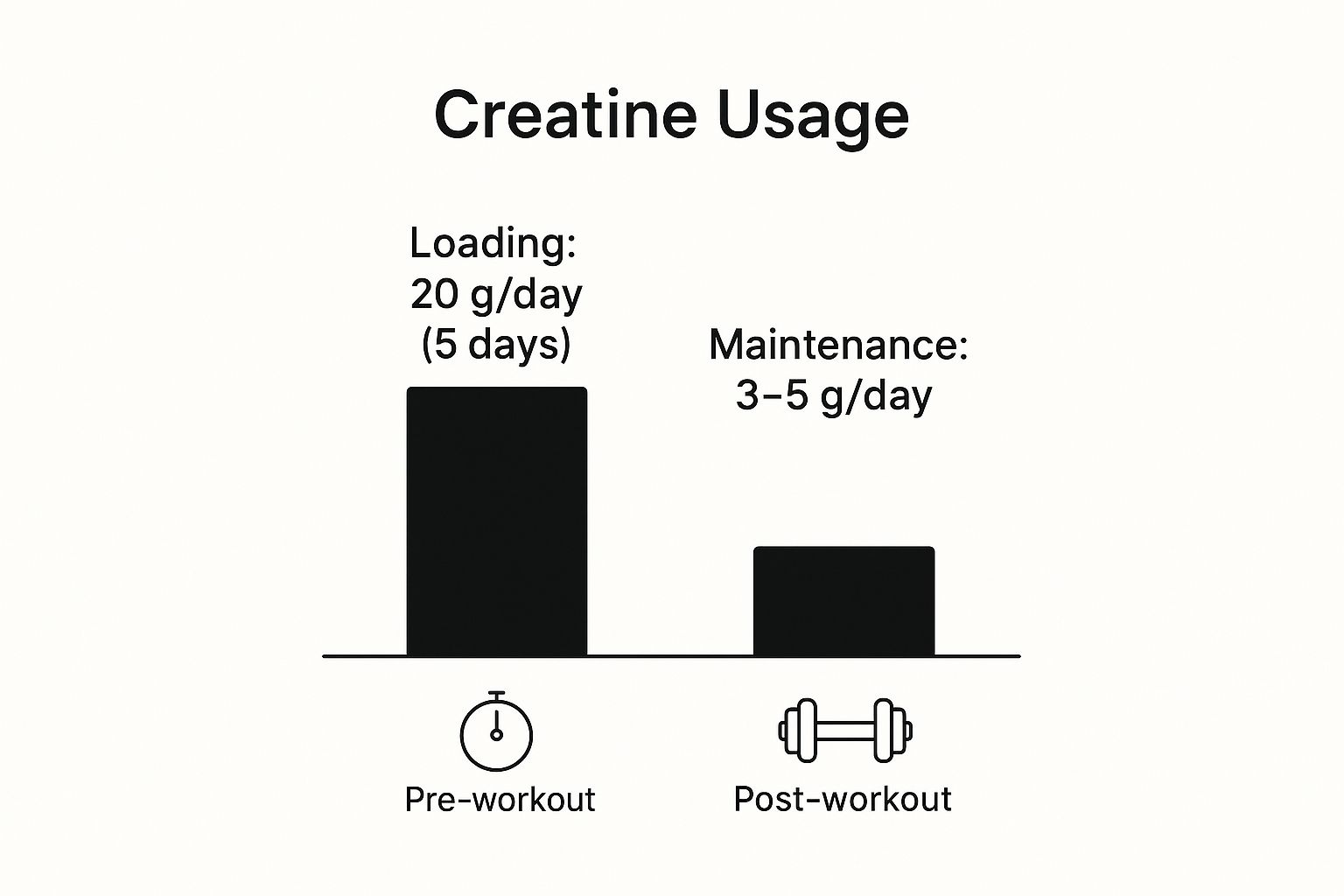
To help you decide, here’s a quick comparison of the two most common creatine dosing protocols.
Creatine Dosing Protocol Comparison
| Protocol Feature | Loading Phase Method | Maintenance Dose Only Method |
|---|---|---|
| Goal | Saturate muscles as fast as possible. | Gradually saturate muscles over time. |
| Daily Dose | 20 grams (split into 4 doses) | 3-5 grams |
| Duration | 5-7 days then drop to maintenance. | Ongoing from day one. |
| Time to Results | ~1 week | ~3-4 weeks |
| Best For | Those wanting the quickest results. | Those who prefer simplicity or have a sensitive stomach. |
Ultimately, both paths lead to fully saturated muscles and the same performance benefits. The choice is yours.
The Loading Phase Method Explained
Think of the loading phase as the express lane to results. The whole point is to fill up your muscle's creatine stores as quickly as humanly possible.
This approach involves taking a higher dose—typically 20 grams per day—for a short 5-7 day window. To avoid potential stomach upset and help your body absorb it all, you'll want to split that dose into four smaller 5-gram servings taken throughout the day.
Once that first week is over, you drop down to a standard maintenance dose of 3-5 grams daily to keep those stores topped off. Simple as that. The upside? You might feel that extra pop in strength within the first week. The downside? Some people find the higher dose causes a bit of bloating initially.
The Maintenance Dose Method
The second route is even more straightforward: just skip the loading phase. With this method, you simply start with the daily maintenance dose of 3-5 grams and stick with it. No messing around with higher doses or splitting servings.
This is the slow-and-steady approach. It takes longer for your muscles to reach full saturation—usually about 3-4 weeks—but the end result is identical. If you value simplicity and want to ease into it, this is the perfect method for you.
The Takeaway: Both roads lead to the same destination. A loading phase gets you there in about a week, while a maintenance-only approach takes a few weeks. The long-term benefits are identical.
If you really want to dial in the perfect amount for your specific goals, our complete creatine dosage guide for beginner to expert results is the next thing you should read.
When Is the Best Time to Take Creatine?
This is one of the most over-analyzed questions out there. Before a workout? After? In the morning? The real answer is much simpler.
When it comes to creatine, consistency trumps timing. Every single time. Creatine delivers results by accumulating in your muscles over days and weeks. The key is taking it daily—including your rest days—to keep your muscle stores full.
Don't sweat the small stuff. Just take it whenever you know you'll remember to. The best time to take creatine is the time you won't forget.
The Importance of Staying Hydrated
One last thing, and it’s a big one: water. Creatine works by pulling more water into your muscle cells, a process called cellular hydration. This is a key part of how it helps with performance and growth.
To help this process along and just feel your best, make sure you're drinking enough water. You don't need to chug a gallon before breakfast, but being mindful of your hydration will ensure you get the maximum benefit from your creatine.
Clearing the Air: The Truth About Creatine Myths
Jump into any online fitness forum, and you'll find a storm of conflicting information about creatine. It's one of the most researched supplements on the planet, yet the myths just won't seem to die. For anyone new to this, the noise can be confusing and frankly, a little intimidating.
Let's cut through all that fiction with some hard facts. Think of this as your personal myth-busting guide. We're going to tackle the biggest rumors head-on with solid science so you can feel confident about what you're doing.
Myth 1: Creatine Is a Steroid
This one is probably the most common—and most wrong—myth out there. Let's be crystal clear: creatine is not a steroid. It's not even in the same ballpark.
Anabolic steroids are synthetic versions of testosterone, designed to manipulate your hormones for muscle growth, and they come with a laundry list of serious side effects. Creatine, on the other hand, is a completely natural compound your own body produces from three amino acids. You also get it from eating everyday foods like red meat and fish.
Here’s a simple way to think about it: a steroid is like a powerful, man-made drug that hijacks your body's hormonal system. Creatine is just a natural fuel source that helps your muscles do their job better. Comparing the two is like comparing a shot of espresso to a potent prescription drug—they operate in completely different worlds.
The International Society of Sports Nutrition, one of the most respected authorities on this stuff, has repeatedly confirmed that creatine is a safe and effective performance aid, totally distinct from anabolic steroids.
It’s a shame this misunderstanding has scared so many people away from one of the most proven supplements available.
Myth 2: Creatine Will Wreck Your Kidneys
The idea that creatine is hard on your kidneys is another stubborn rumor that has been thoroughly disproven by decades of research. This myth likely took root because taking creatine can slightly raise your levels of creatinine—a waste product that doctors check in blood tests to monitor kidney function.
But here's the key: this small bump isn't a red flag for kidney damage. It’s just a harmless byproduct of your body processing the extra creatine. It doesn't mean your kidneys are under any extra strain.
Countless long-term studies on healthy people have found zero evidence of kidney harm. In studies running for as long as five years, participants taking normal doses of creatine showed no negative effects on their kidney function. For the average healthy person, creatine has an outstanding safety record.
Myth 3: Creatine Makes Your Hair Fall Out
Ah, the "creatine causes baldness" theory. This is a classic case of a single, inconclusive study getting blown way out of proportion. The entire rumor is pretty much based on one 2009 study that involved a group of rugby players.
That study found that creatine raised levels of a hormone called Dihydrotestosterone (DHT), which is associated with male pattern baldness. But here are the critical details that often get left out:
- It Didn't Actually Measure Hair Loss: The study never reported that any of the athletes actually lost hair.
- The Findings Haven't Been Repeated: Since then, no other study has been able to replicate these results.
- DHT Levels Stayed in the Normal Range: While DHT did go up, it never went outside the normal, healthy clinical range.
Bottom line? There is no strong scientific evidence directly linking creatine to hair loss. If you're already genetically predisposed to male pattern baldness, you might have concerns, but creatine itself has never been proven to be the trigger.
Myth 4: The "Water Weight" Is Bad for You
You'll hear people say creatine makes you gain "water weight," and technically, that's true. But it’s definitely not the kind of puffy bloating you might be picturing.
Creatine works by pulling water into your muscle cells. This process, known as cellular hydration, is actually a huge benefit. Well-hydrated muscles perform better, recover more quickly, and are primed for growth. This intramuscular water is what makes your muscles look fuller and more defined—not soft or puffy.
So, when the scale ticks up a few pounds during your first week, don't sweat it. That's a great sign! It means the creatine is working exactly as it's supposed to, hydrating your muscles and setting the stage for real gains. It’s functional weight, not fat.
Why Creatine Gummies Are a Beginner’s Best Friend
Let's be real for a second. The whole routine of scooping creatine powder, trying to mix a chalky drink that never fully dissolves, and then having to wash a sticky shaker bottle gets old fast. If you're just starting out, that daily hassle can be the very thing that makes you fall off the wagon.
And with creatine, consistency is everything. It’s the only way to get the results you're after.
This is where gummies completely change the game. They're designed to take all the annoying parts out of the equation, turning your supplement routine from a chore into a simple, even enjoyable, daily habit.
Simplicity and Precision in Every Serving
One of the first hurdles for anyone new to creatine is nailing the dose. When you're using powder, it's all too easy to have a heaping scoop one day and a flat one the next, throwing your intake all over the place.
Gummies eliminate that problem entirely. Each one is made with a precise, pre-measured amount of creatine. You know you’re getting the exact 3-5 grams you need every single time. No guesswork, no inconsistency. It’s just the most reliable way to fuel your muscles correctly day after day.
Creatine works best when you use it consistently to keep your muscles fully saturated. Gummies make that consistency almost effortless by getting rid of the messy, inconvenient steps that cause most people to skip a day.
Convenience That Fits Your Life
Forget the mess for a moment—the sheer grab-and-go nature of gummies is a huge win. You don't need to lug around a giant tub of powder or hunt down a water source and a shaker. Just keep them in your gym bag, on your desk, or throw them in your suitcase.
This kind of convenience helps you build a habit that sticks. Whether you're rushing to the gym after work or you're away for the weekend, you can get your creatine in seconds. When something fits this seamlessly into your life, you're far more likely to stick with it and see real progress.
- No Mess: Finally, you can say goodbye to powder spills and grimy shakers.
- Great Taste: A genuinely good flavor means you'll actually look forward to it.
- Perfect for Travel: They're incredibly easy to pack and take on the go.
By removing all the common roadblocks, creatine gummies make consistency the easiest choice. For a deeper dive into how they work, our complete creatine gummies guide has everything you need to know. It’s the perfect resource for making creatine a rewarding part of your routine.
Got Questions About Creatine? We’ve Got Answers.
Jumping into a new supplement always brings up a few questions. Let's clear up some of the most common things people ask when they're just getting started with creatine.
Should I Take Creatine Every Single Day?
Yes, consistency is everything. Creatine isn't a pre-workout that you only take on gym days; it works by gradually accumulating in your muscles.
Taking your 3-5 grams daily—even on your rest days—is crucial for keeping those muscle stores topped off so they're ready to perform when you need them.
Is Creatine Going to Make Me Puffy?
This is probably one of the biggest myths out there. The water creatine draws into your body isn't the kind that makes you look soft or bloated.
Instead, it pulls water directly into the muscle cells. This process, called cellular hydration, actually makes your muscles look fuller and more defined, which is exactly what most people are looking for.
How Long Until I Actually Notice a Difference?
If you skip the loading phase and stick with the standard daily dose, it generally takes about 3-4 weeks to fully saturate your muscles.
Around that time is when you'll likely start to feel that extra gear in your workouts—maybe an extra rep on the bench press or a little more power in your sprints.
Do I Ever Need to Take a Break from It?
Nope, you can cross that one off your list. Extensive research has consistently shown that long-term creatine use is perfectly safe for healthy people.
There’s no scientific reason to cycle on and off. Just find a way to make it a simple part of your daily routine and stick with it.
When it comes to creatine, remember this: Consistency trumps everything. Taking it daily is far more important than the exact time you take it or whether you bother with a loading phase.
Ready to make creatine the simplest part of your fitness plan? Grab a bottle of delicious, perfectly dosed gummies from Smash.com and feel the difference for yourself. Start building your strength today at Smash.com.


